
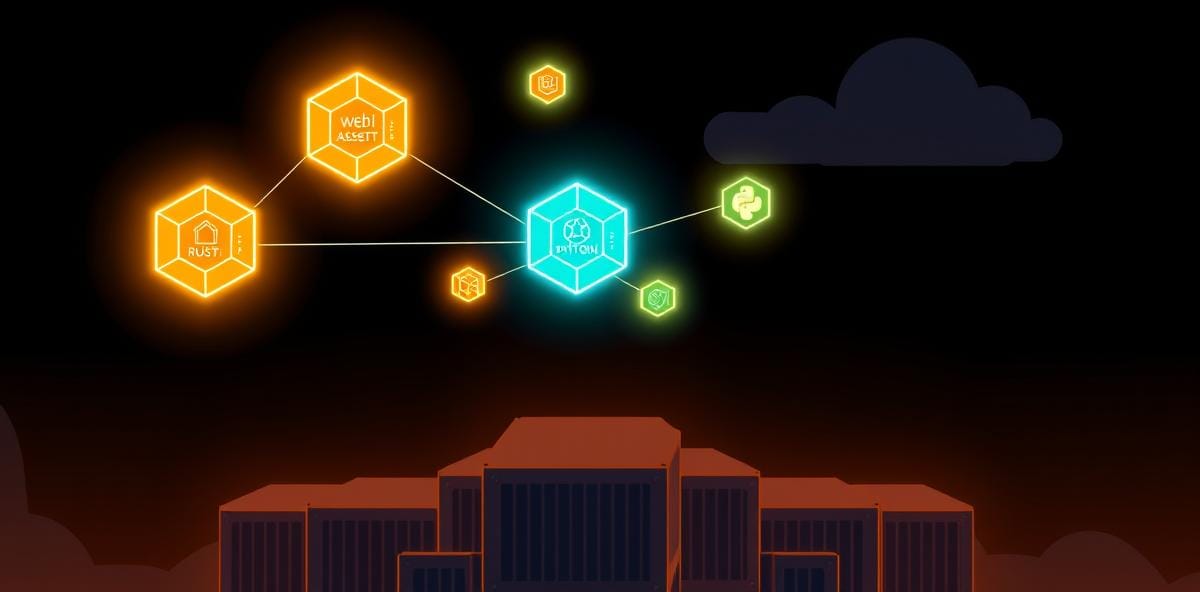
The Architecture That Replaces Containers
In June 2026, WebAssembly 3.0 became a W3C standard, WASI Preview 2 shipped with native async I/O, and Kube-Wasm graduated from the CNCF. Together, these form the foundation of a new architecture pattern: WebAssembly serverless components.
This isn't another container alternative — it's a fundamentally different approach to composing distributed systems.
The Problem with Current Serverless Architectures
Modern serverless platforms like AWS Lambda, Cloudflare Workers, and Deno Deploy solve real problems — cold starts, billing granularity, developer velocity. But they come with hidden costs that compound over time.
Language lock-in. Each platform optimizes for specific runtimes. Lambda's Go and Rust support is solid, but Python and Node.js get the best DX. You're choosing your compute runtime based on platform support, not problem fit.
Opaque execution models. Containers abstract away the OS. Serverless abstracts away both the OS and the container runtime. When something breaks at 3 AM, you're debugging a black box with limited visibility.
Vendor lock-in disguised as portability. "Write once, deploy anywhere" is marketing speak. Cold start behavior, memory limits, execution timeouts, and networking models differ wildly between platforms. Your architecture becomes coupled to quirks you can't control.
Enter WebAssembly Components
WebAssembly 3.0 introduces the Component Model — a standardized way for Wasm modules written in different languages to communicate and compose. It turns Wasm from a sandboxed bytecode format into a system architecture primitive.
A Wasm component is portable, runs anywhere there's a Wasm runtime, and enforces deny-by-default security where every capability must be explicitly granted. Components are language-agnostic — a Rust component can call a Go component through standardized interfaces. They're stateless by design, meaning state lives elsewhere.
The Component Model defines interfaces at the binary level. A component doesn't care if its neighbor is written in TypeScript, Zig, or C++ — it only cares about the interface contract. This is the universal service mesh protocol cloud computing has been missing.
wasmCloud: The Reference Implementation
wasmCloud is the production reference implementation for Wasm serverless components. It runs on Kubernetes with a dedicated operator.
Atomic deployment units. Each component is a compiled Wasm binary, typically 100KB to 5MB — compared to container images at 100MB to 2GB. Deployment becomes fast and storage-efficient.
Explicit capability bonds. Components declare what they need (capability providers) and what they provide (capabilities). The platform handles wiring at runtime. A database component doesn't know it's talking to PostgreSQL versus MongoDB — the provider abstracts that away.
Sandboxed execution. By default, a Wasm component can do nothing — no file I/O, no network access, no system calls. Every capability must be explicitly granted. This isn't security theater; it's architectural clarity. You read a component's permissions and immediately understand its attack surface.
Platform portability. The same component runs on wasmCloud with Kubernetes, Fermyon Cloud, Fly.io edge deployment, local environments, and even embedded devices. Write once and deploy everywhere.
Architecture Patterns for Production
Component-based microservices. Replace traditional microservices where each business capability becomes a component. A Rust user service calls a Go auth provider through standardized interfaces. Swap implementations without changing callers, add capabilities by deploying new binaries, and avoid API versioning entirely.
Multi-cloud with uniform execution. Run the same components across AWS, GCP, and Azure without platform-specific SDKs. The Wasm runtime is your abstraction layer. Teams are already using wasmCloud to run identical workloads across providers, choosing infrastructure based on cost rather than vendor lock-in.
Edge-to-cloud hierarchies. Deploy lightweight Wasm components at the edge for low-latency responses, with heavier backend components in the cloud. Edge authentication and caching run locally while analytics execute only when needed. Each edge component starts in milliseconds.
Plugin systems without plugins. Traditional plugin architectures require language-specific SDKs and often restart the host process. Wasm components are hot-swappable — deploy a new binary without restarting the host. They're sandboxed so a buggy plugin can't crash it. Versioned interfaces enable gradual upgrades.
When to Adopt Now
Greenfield projects. If you're designing a new system in 2026, Wasm components deserve consideration. The ecosystem is mature enough for production, and portability benefits compound over time.
Multi-cloud strategies. If you're running workloads across multiple providers and tired of platform-specific SDKs, Wasm components solve a real pain point containers don't address.
Edge computing at scale. If you're deploying logic to hundreds or thousands of edge locations needing consistent behavior with minimal overhead, Wasm's small binary size and fast startup are compelling.
The Tradeoffs
Cold starts are still a consideration. Wasm components start faster than containers (5-50ms versus 100ms to 2s), but not as fast as native binaries. For latency-sensitive workloads, keep state in the component or use connection pooling.
Debugging requires new tooling. The Wasm ecosystem is maturing, but debugging distributed components across multiple languages isn't trivial yet. You need trace propagation and observability integrations that understand Wasm semantics.
Ecosystem maturity matters. Container orchestration and service meshes have a decade of investment behind them. Wasm tooling is young — you'll build more infrastructure yourself until the ecosystem catches up.
State management becomes your responsibility. Wasm components are stateless by design. You need external storage for persistent state, which scales horizontally but changes how you think about data flow.
The Bigger Picture
WebAssembly serverless components aren't replacing containers — they're adding a new layer to the cloud-native stack. Bare metal and VMs serve maximum control needs. Containers provide application isolation with OS-level flexibility. Wasm components offer portable, sandboxed logic units that transcend language and deployment boundaries.
The ecosystem hit critical mass in 2026. Wasm 3.0 standardized the component model. WASI Preview 2 made async I/O practical for production. Kube-Wasm graduated from the CNCF, signaling enterprise readiness. wasmCloud proved the architecture works at scale.
This isn't hype — it's the next evolution of cloud-native architecture. Teams that adopt early will build systems that are more portable, more secure, and easier to maintain than container-only approaches.

Comments