
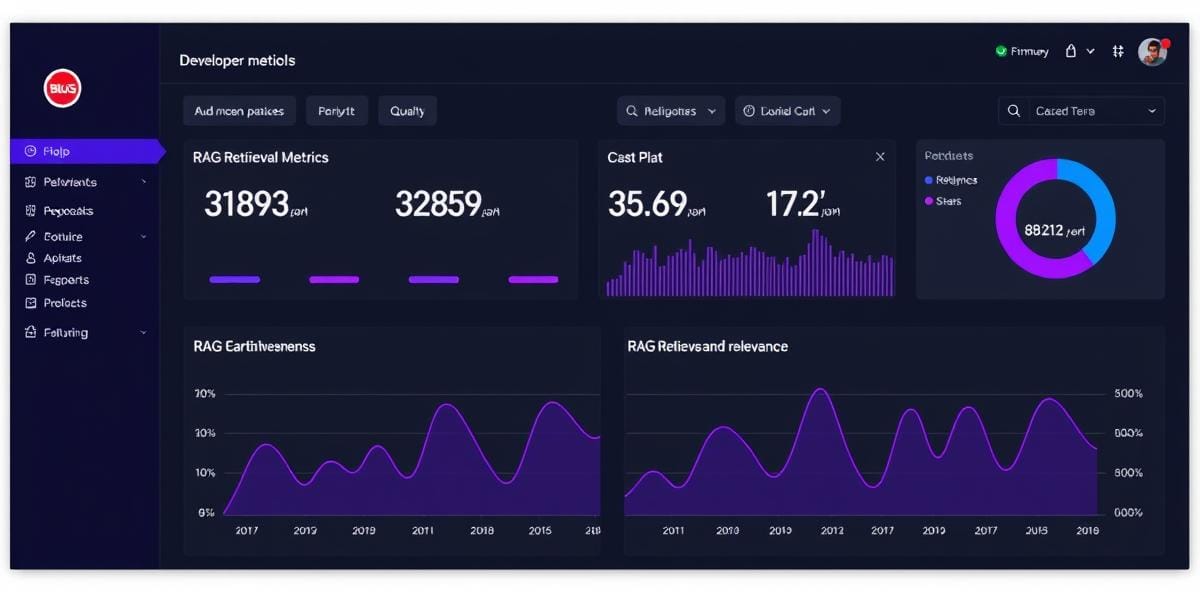
Why Your RAG System Needs Evaluation Before It Reaches Users
Every developer building a RAG application starts with the same instinct: retrieve the right context, generate the right answer. But as one LangChain engineer put it in a 2026 retrospective, "the hardest part of RAG isn't retrieval — it's knowing whether your retriever is actually working." The gap between a prototype that looks impressive in demo mode and a production system that earns user trust is enormous, and the tools to bridge that gap have matured dramatically over the past year.
In 2026, the RAG observability ecosystem has crystallized into five major platforms — Braintrust, Langfuse, Arize Phoenix, LangSmith, and Galileo AI — each solving different slices of the evaluation problem. This guide walks through what matters for production RAG systems and how to choose between these tools based on your team's actual constraints.
The Two Problems Every RAG Team Faces
1. The Evaluation Problem: How Do You Know It Works?
Traditional software testing relies on deterministic assertions — given input X, expect output Y. RAG systems are inherently non-deterministic. Even with a fixed model and seed, retrieval quality varies based on embedding drift, chunking boundaries, and context window pressure. This means you can't simply write unit tests for "does this query return the right answer."
The 2026 approach centers on RAG-specific evaluation metrics: retrieval precision (did the right document actually get retrieved?), faithfulness (did the model answer using only the provided context?), and relevance (is the answer useful to the user?). Tools like Ragas and DeepEval have standardized these metrics, but the real innovation in 2026 is automated eval-to-production loops — where production traces automatically generate evaluation datasets, which then feed back into quality gates that block regressions.
2. The Observability Problem: What's Happening in Production?
Once your RAG system is live, you need to understand three dimensions simultaneously: retrieval performance (what documents are actually being retrieved for each query?), generation quality (is the model hallucinating or grounding its answers?), and user satisfaction (are users actually getting useful responses?).
The breakthrough in 2026 is what Braintrust calls "active observability" — the platform works through production data in the background rather than waiting for you to manually search for issues. Instead of requiring you to tag every trace as "good" or "bad," these tools automatically classify failures by type: retrieval failures, generation failures, context overflow, and latency regressions.
The Five Platforms Compared
| Platform | Best For | Key Strength | Limitation |
|---|---|---|---|
| Braintrust | Full-stack eval-to-release pipeline | Production traces auto-generate eval datasets; quality gates block regressions | Closed ecosystem — tightly coupled to Braintrust's eval framework |
| Langfuse | Open-source observability + prompt management | Hierarchical tracing for RAG workflows; OpenTelemetry integration | Evaluation is secondary to observability — weaker automated scoring |
| Arize Phoenix | Deep embedding analysis and drift detection | Embedding cluster visualization; semantic topic clustering | Stronger for embeddings than generation quality |
| LangSmith | LangChain-native tracing and eval | Seamless integration with LangChain chains and agents | Best when you're already committed to the LangChain ecosystem |
| Galileo AI | Failure clustering and LLM-as-judge scoring | Automated failure categorization; strong for complex generation tasks | Premium pricing; less suited for retrieval-focused diagnostics |
A Practical Production Pattern: The Eval Loop
The most successful RAG teams in 2026 follow a specific pattern that transforms production chaos into systematic improvement. Here's what it looks like in practice:
- Capture everything: Instrument your RAG pipeline to log every retrieval step, every context window fill, and every generation. Use OpenTelemetry or native tracing to ensure you have complete visibility.
- Automate quality scoring: Run LLM-as-judge evaluations on a sample of production traces (typically 5-10% of traffic). Score for faithfulness, relevance, and retrieval precision. Store these scores alongside the original traces.
- Cluster failures automatically: Use embedding-based clustering or topic modeling to group similar failures together. A single "retrieval failure" might actually be three different problems: chunking too small, embedding drift, or query rewriting gone wrong.
- Create quality gates: Define minimum thresholds for key metrics (e.g., "retrieval precision must stay above 0.7, faithfulness above 0.85"). Block releases if metrics regress below these thresholds.
- Feed production into evaluation datasets: Automatically promote high-quality production interactions to your evaluation dataset. This creates a self-improving loop where real user data continuously strengthens your test coverage.
The Hidden Cost: When Observability Becomes Overhead
No honest guide would ignore the costs. Full RAG observability adds roughly 15-30% latency overhead to your pipeline due to tracing, scoring, and storage. For high-traffic applications, this translates to meaningful infrastructure costs — especially when you're storing millions of traces with full context windows.
The pragmatic approach most teams adopt is tiered observability: log everything for the first 7 days at full fidelity, then downsample to aggregated metrics (retrieval precision by query type, generation quality by model version) for long-term retention. This gives you enough data for trend analysis without the storage burden of keeping every single trace forever.
Getting Started: A Minimal Viable Setup
If you're just starting with RAG evaluation, don't try to implement all five platforms. Start with this minimal setup:
- Langfuse (self-hosted): Deploy via Docker Compose. Instrument your retrieval and generation steps with hierarchical spans. Use the built-in prompt management for versioning your prompts.
- Ragas or DeepEval: Run batch evaluations on a weekly cadence against a curated test set of 100-200 queries. Track metric trends over time.
- Manual review: Spend 30 minutes per week reviewing the worst-performing traces. This human-in-the-loop step catches edge cases that automated scoring misses.
Once you've established this baseline, gradually adopt more sophisticated patterns — automated quality gates, production-to-eval feedback loops, and active observability features from platforms like Braintrust or Galileo AI. The key insight is that RAG evaluation isn't a one-time setup; it's an ongoing practice that compounds in value as your system matures.
The best RAG systems in 2026 aren't the ones with the fanciest retrieval architectures — they're the ones with the most rigorous evaluation practices. Start simple, measure consistently, and let production data drive your improvements.


Comments