
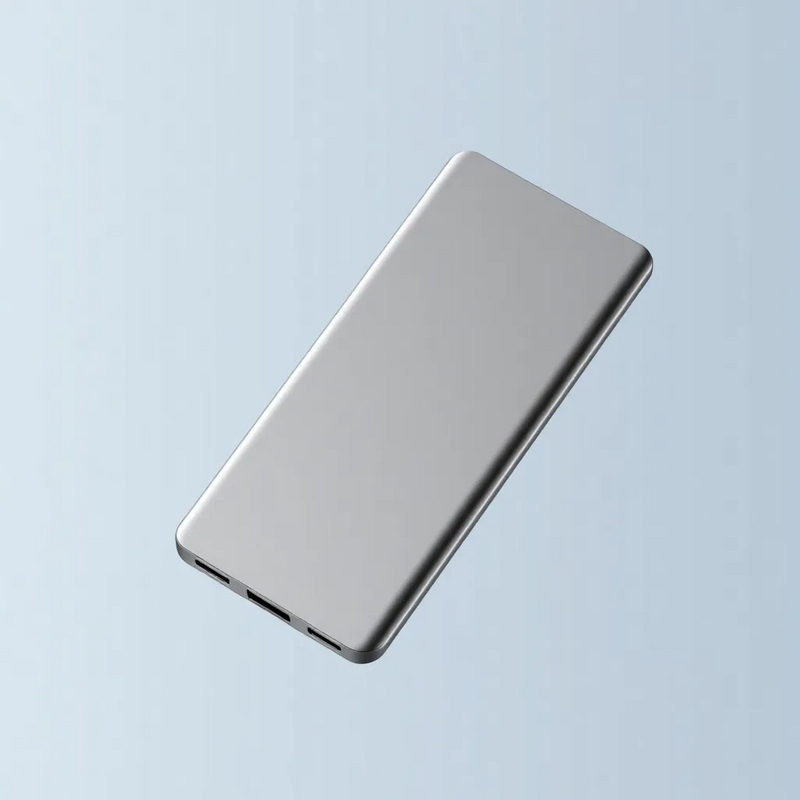
Silicon-Carbon Battery Technology — The Xiaomi UltraThin Power Bank and the Case for Restraint
At 6 millimeters thick, the Xiaomi UltraThin Magnetic Power Bank is thinner than virtually every smartphone on the market. It weighs 98 grams, holds 5,000 mAh, and costs €60. None of these numbers alone would make a headline. Together, they represent a quiet engineering win that most tech coverage has overlooked.
The real story isn't the power bank itself. It's the silicon-carbon battery chemistry that makes it possible, and what this tells us about a shift in consumer electronics design philosophy — from feature accumulation toward material and dimensional restraint.
The Silicon-Carbon Breakthrough
Conventional lithium-ion and lithium-polymer batteries have been incrementally improving for two decades. The anode — the electrode that stores lithium ions during charging — is traditionally graphite-based. Graphite works well, but it's approaching practical limits in terms of how densely it can pack energy per cubic millimeter.
Enter silicon. Silicon can theoretically store roughly ten times more lithium ions per unit mass than graphite, making it the holy grail of anode materials. The problem has always been mechanical: silicon expands by up to 300% when lithium ions intercalate into it during charging. This expansion causes cracking, delamination, and rapid capacity fade — a battery that works great for fifty cycles and dies afterward.
Xiaomi's GSR (Graphite-Silicon-Rich) silicon-carbon anode takes a pragmatic middle ground. Rather than pure silicon, they blend 16% silicon content into the anode structure, paired with a 4369mm² graphite heat dissipation sheet. This isn't a pure breakthrough; it's an engineering compromise that prioritizes durability over theoretical maximums. The result is an energy density of up to 840Wh/L — respectable but not record-shattering — with the crucial advantage of actually lasting through hundreds of charge cycles.
This 16% silicon content figure matters because it signals that silicon-carbon technology has moved from lab curiosities into mainstream production. Samsung, Apple, and CATL are all pursuing similar blends, suggesting this will become the industry standard within the next few years.
Why Thickness Actually Matters
The 6mm form factor isn't just aesthetic vanity. It fundamentally changes how a power bank integrates into daily use patterns.
Traditional power banks are bulky rectangles you either leave at home or carry in a pocket where they create a visible bulge. The psychological friction of that bulge means most people charge their power bank on a desk and forget it until they're desperate. A 6mm unit sits flush against a phone's back surface, or slips into a jacket pocket without creating a profile. It becomes invisible infrastructure — the goal of all good portable power.
The magnetic attachment to iPhones (via MagSafe) and Xiaomi 17 series phones removes another friction point: the need to connect and disconnect cables. You bring a device that charges itself when you're home, and provides emergency juice when you're not. The workflow is simpler, which means people actually use it.
The Capacity Tradeoff
Here's where the tradeoffs become clear. At 5,000 mAh, this power bank won't fully recharge most modern flagship phones from zero. An iPhone 16 Pro has roughly a 3,300 mAh battery — so you'd get about 1.3 full charges. A phone with a 5,000 mAh battery gets exactly one full charge. A phone with a 6,000 mAh battery gets about 80%.
This isn't a failure. It's a deliberate positioning. The UltraThin isn't designed for camping trips or long flights. It's designed for the gap between "my phone is at 20% and I won't see a wall charger for four hours" and "I need to get home with enough battery to call a ride." That's actually the use case for most people, most of the time.
The 10,000 mAh version exists if you need more capacity — but at double the thickness and weight. You can't have both, and Xiaomi has chosen thin.
Charging Speeds and Real-World Performance
Wireless charging tops out at 15W with Xiaomi 17 series phones and 7.5W for iPhones — the latter capped by Apple's MagSafe restrictions. The USB-C port pushes 22.5W wired charging, and the unit can charge two devices simultaneously.
A 15W wireless charge takes roughly two hours to refill the power bank. But speed is another variable in the restraint equation: higher power means larger components, more heat, thicker form factors. The UltraThin accepts moderate speed in exchange for maintaining its physical profile.
The Sustainability Angle
There's a sustainability argument here that rarely gets discussed. A power bank that's 6mm thick uses less aluminum, less plastic, less packaging, and occupies less shelf space than its chunkier competitors. It's lighter to ship. The silicon-carbon chemistry extends cycle life, meaning fewer replacements over the product's lifespan.
But the real sustainability question is whether people will buy fewer power banks if each one actually fits into their daily carry. If the UltraThin eliminates the need to keep a separate "travel power bank" and "desk power bank," the net material savings could be significant.
What This Means for the Industry
The Xiaomi UltraThin is a proof of concept that silicon-carbon batteries are commercially viable at consumer price points. Once one manufacturer demonstrates the economics work, competition follows. We'll see Samsung, Apple, Anker, and others launching similarly thin products — driving prices down further.
This is the kind of incremental progress that doesn't make headlines but quietly improves people's lives. The next time you reach for a power bank and it doesn't feel like you're also carrying a paperback book, this silicon-carbon chemistry will have done its job.
The Xiaomi UltraThin isn't perfect. The 5,000 mAh capacity is a constraint. The €60 price isn't the cheapest on the market. But it represents a design philosophy — restraint over excess, thinness over capacity, integration over bulk — that the consumer electronics industry could use more of.
And that's worth paying attention to.
Comments