
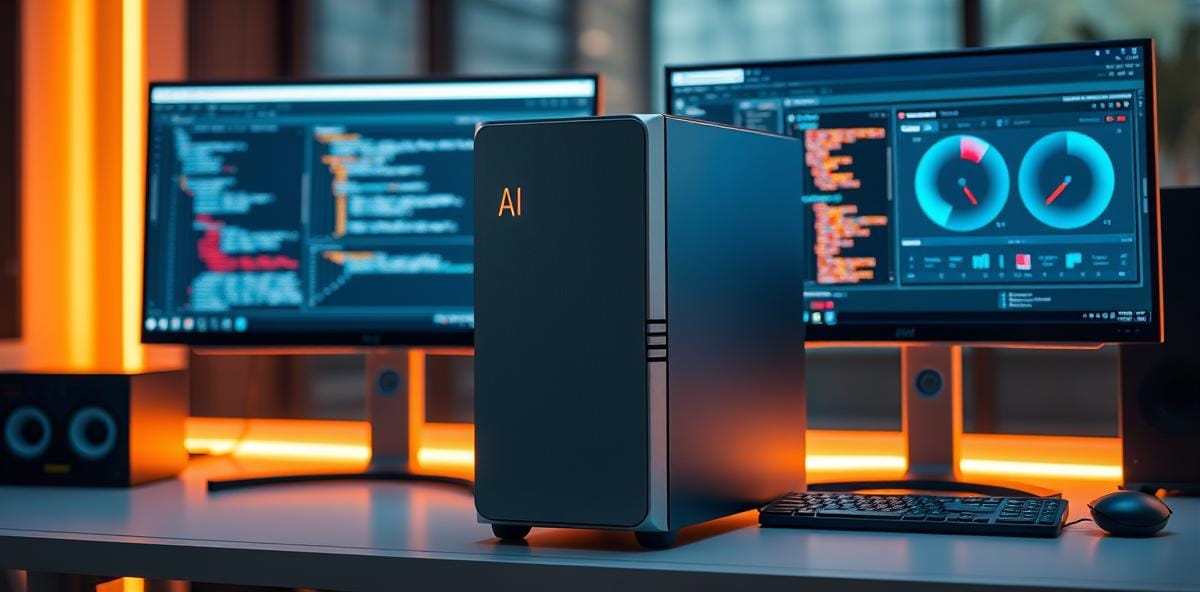
The Desktop AI Supercomputer Revolution Has Arrived — And It Fits on Your Desk
Six months ago, running a large language model locally meant truncated context windows or burning through your budget on cloud GPU time. As of mid-2026, the equation has shifted dramatically. Desktop AI compute appliances are arriving under $3,000 with performance that makes cloud inference look like an unnecessary expense for many workflows.
The category anchor is the ASUS Ascent GX10, a compact box packing NVIDIA's GB10 chip — delivering one petaFLOP of AI-accelerated compute with 128GB of unified memory. At $2,999, it targets exactly what developers want most: on-premise model fine-tuning and local LLM inference without the latency or privacy trade-offs of cloud APIs.
Why This Matters for Developers
The implications go far beyond hobbyist curiosity. Here is why this hardware shift deserves your attention:
- Privacy by default. Your code, your data, your prompts — none of it leaves the machine. For teams working with proprietary architectures or sensitive customer data, eliminating egress removes an entire compliance headache.
- No rate limits. Cloud API providers impose token budgets and request-per-minute caps that bottleneck development. A local petaFLOP machine has only one limit: your electricity bill.
- Fine-tuning at last mile. Training LoRA adapters on domain-specific datasets used to require multi-thousand-dollar cloud instances booked weeks in advance. The GX10's 128GB unified memory holds a quantized 70B-parameter model with headroom for the training context window.
- Predictable costs. A $3,000 capital expense amortizes to roughly $250 per month over a year — versus an A10G cloud instance at over $800 monthly, before data transfer fees.
The Hardware That Makes It Possible
NVIDIA's GB10 represents a deliberate pivot from datacenter GPUs toward edge-class density. The chip consolidates what previously required an entire server rack into a thermally managed desktop enclosure. Key architectural choices include:
- Unified memory architecture. Unlike traditional GPU setups where VRAM and system RAM are separate pools with slow PCIe bridges between them, the GB10 uses a single 128GB pool accessible by both CPU cores and AI tensor units at full bandwidth. This eliminates the painful model-sharding workarounds developers currently implement to fit large models into limited VRAM.
- Dedicated FP8 tensor cores. The GB10 includes hardware acceleration for 8-bit floating-point arithmetic, which is the precision format most quantized LLMs use. Running inference in FP8 natively rather than emulating it through software libraries yields roughly a two-to-three times throughput improvement over last-generation consumer GPUs.
- Compact thermal design. The GX10 enclosure uses vapor chamber cooling and variable-speed fan curves that keep noise below 35 decibels during sustained inference loads — quiet enough for an open-plan office or home workspace.
Beyond the ASUS Ascent: The Broader Landscape
The GX10 is not alone. Several complementary devices are reshaping what "local AI" means across different form factors:
Acer AR Vision GR0 ($499) — Dual 1080p micro-OLED glasses projecting a virtual 172-inch screen via USB-C. Designed for developers running local inference while viewing code, model outputs, and documentation simultaneously.
Dell UltraSharp 52 ($2,899) — A 52-inch 6K IPS Black panel with Thunderbolt 4 KVM switching. Pair this with a GX10 for a workstation that replaces both your primary monitor and cloud terminal.
What You Can Actually Do With It
The most compelling use cases for desktop AI supercomputers cluster around three patterns:
- Local RAG pipelines. Ingest your codebase and docs into a local embedding model. Query with natural language — no API keys or data egress required. Stack Ollama for serving, ChromaDB for vectors, and a local LLM for generation.
- Model distillation experiments. Run a large teacher model to generate training data, then fine-tune a smaller student model on the same machine. The unified memory architecture lets you hold both models simultaneously during evaluation.
- Real-time code assistance offline. Connect your editor to a locally hosted coding model through standard tool-use protocols. Every keystroke stays local; response latency drops from 200-500ms on cloud APIs to under 100ms.
The Catch
No revolution is without friction. The desktop AI supercomputer category still has meaningful limitations:
- Model size ceiling. Even with 128GB unified memory, you cannot run the largest frontier models unquantized. A full-precision 70B-parameter model requires roughly 140GB. Quantization to 4-bit or 8-bit is still necessary for anything beyond ~50B parameters.
- Maintenance burden. You are responsible for driver updates, firmware patches, cooling maintenance, and hardware replacement when components fail. Cloud providers absorb this cost into your monthly bill; local ownership means you trade money for operational responsibility.
The Verdict
The arrival of sub-$3,000 desktop AI supercomputers marks a genuine inflection point. For developers who prioritize data sovereignty, predictable costs, and low-latency inference, these machines solve real problems cloud APIs cannot address at comparable price points.
You do not need one if your workloads are simple prompt-to-answer interactions with public models. But if you are fine-tuning domain-specific models, building private RAG systems, or tired of watching API budgets evaporate — the desktop AI supercomputer is practical infrastructure that fits on your desk.
The best time to evaluate local AI hardware was when prices were high and performance was uncertain. The second-best time is now, before the next generation makes today's petaFLOP look quaint.
Bottom line: The ASUS Ascent GX10 represents the most accessible path to serious local AI compute in 2026. If your workflow involves model training, private inference, or heavy API usage, it is worth the investment.
Comments