
Polyglot Persistence in Event-Driven Microservices: Choosing the Right Database for Each Service
In a monolith, you get one database. It does everything — queries, caching, search, sessions. Simple, rigid, and eventually painful at scale. Microservices change the game by giving each service its own data layer. But with that freedom comes responsibility: which database should each service use?
Polyglot persistence answers that question with a simple principle — use the best storage technology for each service's specific needs. Combine it with event-driven communication, and you get a system where services are truly autonomous, scalable, and resilient.
The Core Idea: Database per Service
In a microservices architecture, every service owns its data exclusively. No shared schemas, no foreign keys across services, no two services querying the same database directly. Each service picks whatever datastore fits its workload:
- PostgreSQL for transactional services that need ACID guarantees — user accounts, billing, order processing.
- MongoDB for content-heavy services with flexible schemas — blogs, catalogs, product listings.
- Redis for session management, caching layers, and real-time leaderboards where millisecond reads matter.
- Elasticsearch for full-text search services that power autocomplete, faceted filtering, and log analysis.
- Cassandra or DynamoDB for high-write-throughput services like IoT telemetry or activity feeds.
- Neo4j for graph relationships — social networks, recommendation engines, fraud detection.
The key insight is that no single database excels at everything. A relational store handles joins and transactions beautifully but struggles with unstructured data and horizontal scaling. A document store scales horizontally effortlessly but can't do reliable multi-row transactions. Polyglot persistence lets each service use what it's best at.
How Services Stay in Sync Without Shared State
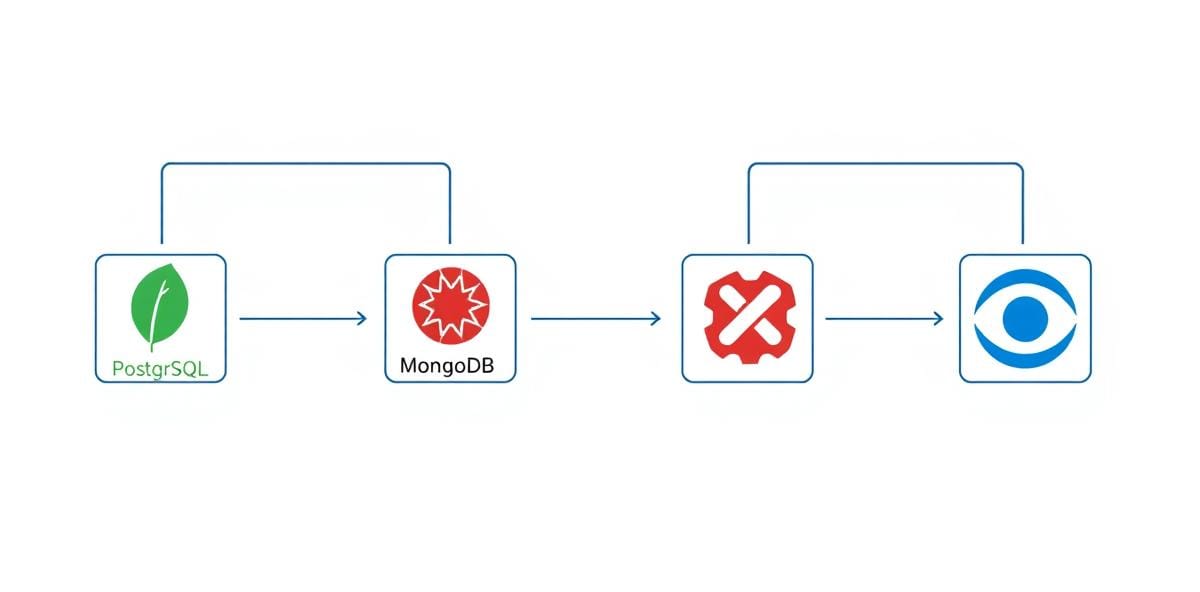
The hard part of polyglot persistence isn't choosing databases — it's keeping data consistent across them when the same business entity spans multiple services. When a user updates their email, that change needs to reach the authentication service (PostgreSQL), the notification service (MongoDB), and the analytics pipeline (Elasticsearch). Direct database replication or shared transactions break service autonomy.
Event sourcing with Change Data Capture solves this elegantly:
- A service performs a write to its own database.
- A CDC connector (like Debezium) captures the change from the database's transaction log in real time.
- The change is published as an event to a message broker — Kafka, RabbitMQ, or AWS SNS/SQS.
- All interested services consume the event and update their own stores accordingly.
This means no service ever talks directly to another service's database. Communication happens exclusively through events, preserving loose coupling and independent deployability.
Practical Patterns for Implementation
The Outbox Pattern is a practical technique for reliable event publishing. Instead of writing to the database and then separately publishing an event (which can fail halfway), you:
- Write both the business data and the event record into a local
outboxtable in the same transaction. - A separate process reads from the outbox table and publishes events to the broker.
- Once published, the outbox entry is marked as delivered.
This guarantees that every database write has a corresponding event — no data loss, no orphaned updates. It's a simple pattern with enormous reliability benefits.
Saga Orchestration handles multi-service transactions when you need coordinated actions across services. If an order service needs to reserve inventory in the stock service and charge payment in the billing service, a saga coordinates the steps. Each step is its own database write plus an event. If any step fails, compensating events are published to undo previous changes. It's eventually consistent by design — you trade immediate consistency for autonomy.
The Costs You Shouldn't Ignore
Polyglot persistence isn't free. Every additional database technology adds operational complexity:
- Operational overhead: PostgreSQL admins don't automatically know how to tune MongoDB or Elasticsearch. Your team needs breadth, or you need strong SRE support.
- Data consistency challenges: Without shared transactions, eventual consistency becomes the default. Applications must be designed to handle stale reads and duplicate events.
- Monitoring complexity: A single service call may touch three different databases across two services. Tracing and observability become non-negotiable.
- Backup and recovery: Different databases mean different backup strategies, retention policies, and disaster recovery plans.
The rule of thumb: don't introduce polyglot persistence prematurely. Start with one well-chosen database for the entire application. Only split when a specific service's data requirements genuinely conflict with your current stack — and only then pick the tool that matches the workload, not the trend.
When to Reach for Polyglot Persistence
It makes sense when:
- Your services have fundamentally different data access patterns (one needs sub-millisecond reads, another needs complex analytical queries).
- You're scaling beyond what a single database can handle efficiently.
- Different teams own different services and need independent technology choices.
- Event-driven real-time processing is a core requirement of your domain.
If you're still small, a well-indexed PostgreSQL with Redis for caching covers 90% of use cases. Don't over-engineer. But when the time comes, polyglot persistence in an event-driven architecture is one of the most powerful scaling patterns available.
The best architecture isn't the one with the most databases — it's the one where each database earns its place by solving a real problem better than anything else could.

Comments