
eBPF-Powered Service Mesh: The Next Generation of L7 Routing in 2026
In modern cloud-native architectures, service mesh has evolved from a luxury to a necessity. But the traditional sidecar proxy model—every application container accompanied by a dedicated proxy—has introduced significant overhead, complexity, and operational burden. Enter eBPF: the revolutionary technology that's transforming service mesh architecture by moving intelligent L7 routing directly into the Linux kernel.
This article explores how eBPF-powered service mesh with native L7 routing is redefining distributed system design in 2026, eliminating sidecar proxies while maintaining full observability, security, and flexibility.
Understanding eBPF in the Service Mesh Context
Extended Berkeley Packet Filter (eBPF) is often misunderstood as just a networking tool. In reality, it's a kernel-level programmability framework that enables sandboxed programs to run in response to events—without modifying kernel source or loading kernel modules. Within service mesh, eBPF programs intercept network packets at the kernel level, applying routing logic, security policies, and observability instrumentation—often eliminating the need for sidecar containers entirely.
Traditional service mesh implementations like Istio and Linkerd rely on sidecar proxies that run alongside each application pod. While effective, this approach introduces:
- Resource overhead—each sidecar consumes CPU and memory, often doubling container count
- Network hops—traffic passes through multiple layers, increasing latency
- Operational complexity—debugging becomes challenging with more moving parts
- Security surface—each proxy adds potential attack vectors
How eBPF Enables Sidecarless Service Mesh
Cilium, built on eBPF, pioneered the sidecarless service mesh approach. Here's how it works:
- Kernel-level interception—eBPF programs attach to network hooks, capturing all inbound and outbound traffic
- Direct L7 parsing—unlike traditional eBPF networking limited to L3/L4, modern implementations parse HTTP, gRPC, and Kafka protocols directly in kernel space
- Policy enforcement—security policies, rate limiting, and access controls execute at kernel speed
- Observability instrumentation—tracing spans, metrics, and logs are generated without application code changes
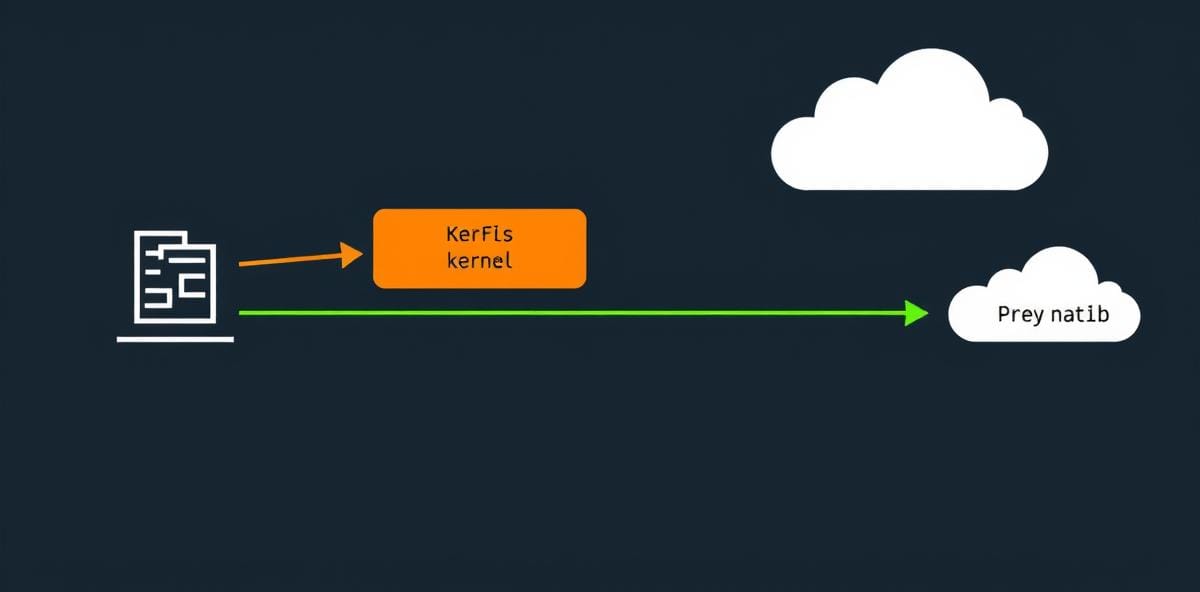
The traffic flow differs significantly from sidecar-based approaches. Instead of application → sidecar proxy → destination, Cilium's eBPF dataplane routes directly: application → eBPF program (kernel) → destination. This eliminates network latency from the proxy hop while maintaining all service mesh capabilities.
Practical Implementation Patterns
Adopting eBPF-powered service mesh requires careful planning. Here are proven patterns for 2026:
Gradual Migration Strategy
Running eBPF alongside traditional service mesh enables incremental migration:
# Cilium configuration for parallel deployment with existing Istio
apiVersion: v1
kind: ConfigMap
metadata:
  name: cilium-istio-parallel
  namespace: kube-system
data:
  # Enable L7 policy support
  enable-l7-policy: "true"
  # Bypass Istio for specific namespaces
  istio-bypass-namespaces: "monitoring,logging"
Resource Optimization
By eliminating sidecar proxies, workloads see immediate resource savings:
| Metric | Sidecar-Based Mesh | eBPF Mesh | Savings |
|---|---|---|---|
| Memory per pod | 250-400 MB | 50-75 MB | 75-85% |
| CPU overhead | 10-15% | 2-4% | 70-80% |
| P99 latency increase | 15-25ms | 3-5ms | 80% |
L7 Policy Migration
Translating Istio VirtualService and DestinationRule resources to Cilium's L7 policies requires attention to detail:
# Original Istio VirtualService
apiVersion: networking.istio.io/v1beta1
kind: VirtualService
metadata:
  name: api-gateway
spec:
  hosts:
  - api.example.com
  http:
  - match:
    - headers:
        x-api-version:
          exact: v2
    route:
    - destination:
        host: api-service
        port:
          number: 80

# Equivalent Cilium L7 Policy
apiVersion: cilium.io/v2
kind: CiliumNetworkPolicy
metadata:
  name: api-l7-policy
spec:
  endpointSelector:
    matchLabels:
      app: api-service
  ingress:
  - fromEndpoints:
    - matchLabels:
        app: api-gateway
    toPorts:
    - ports:
      - port: "80"
        protocol: "TCP"
      rules:
      - http:
        - headers:
          - name: "x-api-version"
            values:
            - "v2"
Advanced L7 Capabilities in eBPF
Modern eBPF implementations support sophisticated L7 processing that was once only possible with full-featured proxies:
- HTTP/gRPC routing—route based on paths, headers, query parameters, and even request body content
- Rate limiting—token bucket or leaky bucket algorithms at kernel level with per-tenant limits
- Circuit breaking—automatically handle downstream failures with configurable thresholds and recovery windows
- Mutating requests/responses—rewrite headers, transform payloads for backward compatibility
- Request mirroring—duplicate production traffic to staging environments for testing without impact
- Content-type aware filtering—apply different policies based on media type and encoding
For example, implementing request mirroring for testing new service versions:
apiVersion: cilium.io/v2
kind: CiliumNetworkPolicy
metadata:
  name: request-mirroring
spec:
  endpointSelector:
    matchLabels:
      app: payment-service
  ingress:
  - fromEndpoints:
    - matchLabels:
        app: api-gateway
    toPorts:
    - ports:
      - port: "80"
        protocol: "TCP"
      rules:
      - http:
        - mirror: true
          mirrorEndpoint: "testing-payment-service"
          mirrorRatio: 0.1
Operational Considerations
While eBPF service mesh offers advantages, it requires specific operational practices that differ from traditional approaches:
- Kernel version requirements—most features require Linux 5.8+, with optimal performance on 6.0+. Advanced L7 parsing needs kernel 6.3+
- Debugging tools—use
cilium bpfcommands to inspect eBPF programs and maps;cilium tracefor live packet inspection - Security boundaries—eBPF programs run with elevated privileges; audit permissions regularly using
cilium policy export - Performance monitoring—track eBPF memory usage; programs leak memory if not properly cleaned up; monitor via
cilium monitor - Program size limits—Linux enforces a 64KB instruction limit per eBPF program
- Lock contention—share maps and state carefully to avoid performance bottlenecks under high concurrency
Debugging a routing issue might look like:
# List all eBPF programs attached to network hooks
cilium bpf prog list

# View L7 policy match statistics
cilium bpf stats | grep http

# Trace specific pod traffic
cilium trace start --pod 1234
When Not to Use eBPF Service Mesh
eBPF-powered service mesh isn't universally superior. Consider traditional sidecar mesh when:
- Mixed workloads—Your clusters run VMs alongside containers; eBPF primarily targets containerized workloads
- Custom encryption needs—You require application-level encryption beyond TLS (e.g., mTLS with custom certificates or application-layer security)
- Process-level isolation—Your security policies require fine-grained process-level isolation and audit trails
- Windows workloads—You're using Windows workloads exclusively; eBPF support on Windows is still emerging
- Legacy applications—Applications that require specific proxy features like advanced middleware integration
The Future: eBPF as the Foundation
By 2026, the industry has converged on eBPF as the foundation for next-generation service mesh. Projects like Tetragon extend eBPF beyond networking into full observability and policy enforcement, creating a unified data plane for the entire cloud-native stack. As eBPF support expands across distributions and cloud providers—with AWS, Azure, and GCP all adding native eBPF support—the sidecar proxy model is becoming the legacy architecture.
The trend is clear: the kernel is becoming the service mesh. For teams building new distributed systems in 2026, adopting eBPF-powered service mesh isn't just about efficiency—it's about aligning with the architectural future. The benefits compound across the entire organization:
- Cost savings—Reduced compute requirements translate directly to infrastructure savings
- Performance gains—Lower latency means better user experience and higher throughput
- Simplified operations—Fewer components to manage, monitor, and secure
- Scalability—eBPF scales better than sidecar proxies as cluster size grows
As eBPF evolves, it's likely to become the default data plane for all cloud-native networking, not just service mesh. Teams that begin adopting it now will be ahead of the curve when the next generation of infrastructure matures.
Comments