
The Hidden Backbone of Every Production AI Agent
You've seen the demos. An agent reads your repository, plans a refactor, writes the code, runs tests, and opens a pull request — all without you touching the keyboard. But there's a quiet gap in almost every agent architecture that nobody talks about until it breaks: memory.
In 2024, agent memory was largely experimental. Graph-based memory stores, embedding-based retrieval, and ad-hoc conversation history were the norm. By mid-2026, the pattern has crystallized into something production-grade. The question is no longer whether your agent needs memory — it's which tiered architecture serves your use case without bankrupting your inference budget.
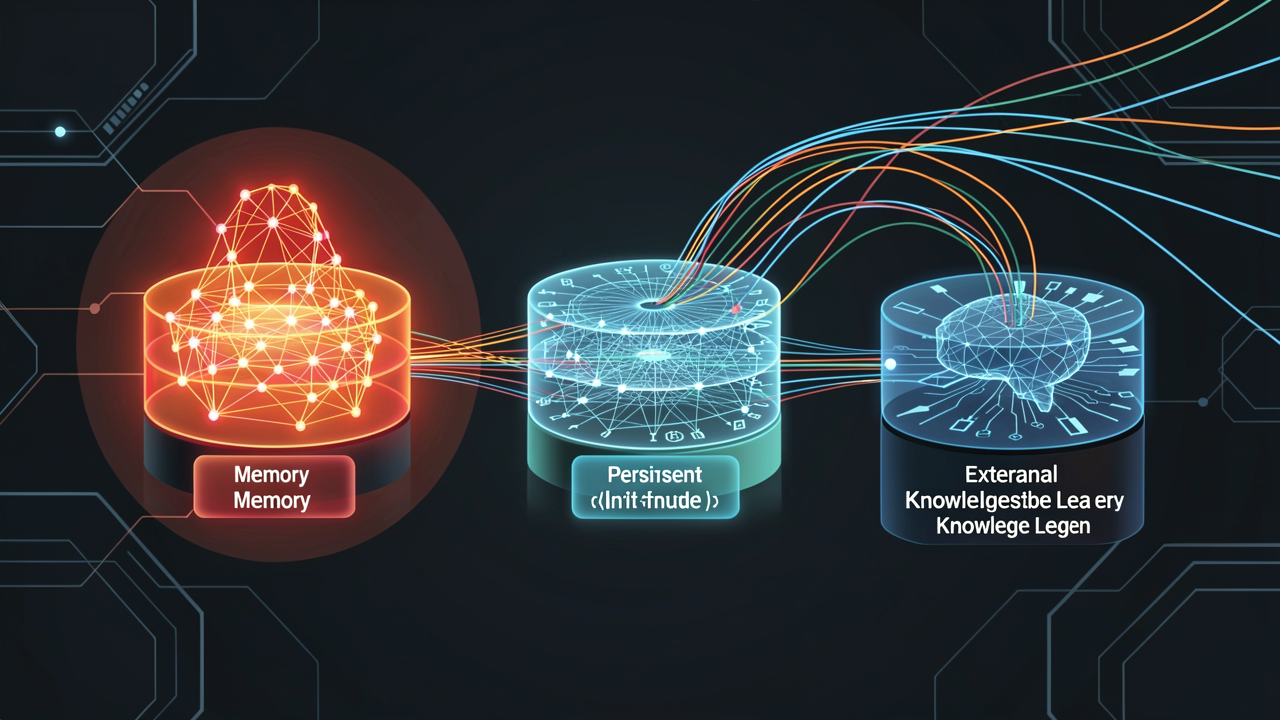
The Three Tiers of Agent Memory
Every production agent needs three distinct memory systems. Mixing them up is the most common architectural mistake.
Short-term (working) memory is the conversation context window — the current task, recent tool calls, and intermediate reasoning steps. It fits inside your LLM's context (128K to 1M tokens), and is ephemeral by design. Alice Labs' production approach compresses older turns into a running summary while preserving the most recent 8,000 tokens for active reasoning, keeping context costs bounded.
Long-term (persistent) memory stores learned preferences, user facts, and historical decisions across sessions. Mem0 is the production default in 2026. Unlike short-term memory, this data survives session boundaries and is typically backed by a vector database with semantic retrieval. The critical insight: long-term memory is not a dump of everything — it's a curated store of high-salience facts.
External memory is the project itself — codebase, documentation, and schemas. The agent reads it on demand. For small repos, naive chunking works. For monorepos, you need graph-based indexing or hybrid retrieval combining semantic search with structural awareness.
The Dual-Tier Architecture That Actually Scales
The production pattern is a dual-tier memory system. Redis handles the hot path — short-term session state and active tool call histories needing sub-millisecond access. A vector database (Pinecone, Weaviate, or pgvector) handles the cold path — semantic search over long-term memories.
LangChain explicitly separates these concerns: thread-scoped state in Redis for speed, cross-thread persistent stores in the vector DB for depth. The two-tier split is now the standard starting point.
Here's what the architecture looks like in practice:
Session starts
  → Load short-term context from Redis (session key: agent:{user_id}:{session_id})
  → Query long-term memory store for relevant facts (semantic similarity, top-k=5)
  → Inject both into system prompt
  → On each tool call, append to Redis hot store
  → Periodically: summarize older Redis entries, upsert salient facts to vector DB
  → Session ends: persist summary, evict raw context from Redis
The summarization step is where most implementations fail. Raw tool call histories make for noisy vector stores. The summarization layer should extract structured facts — preferences, conventions, resolved decisions — as clean, queryable entries. Mem0 handles this automatically; custom implementations need an explicit summarization model.
Memory Retrieval: The Hidden Performance Bottleneck
Every memory retrieval call adds latency and cost. A well-designed agent retrieves memory selectively, not on every turn. The pattern is to batch retrieval: collect tool call outputs for 3-5 turns, then trigger a single memory query that covers the accumulated context. This reduces retrieval calls by 60-70% while actually improving relevance, since the query has richer context.
Another critical optimization is memory eviction. Without a TTL or relevance-based eviction strategy, your vector store grows unboundedly. Production systems typically use a combination of recency (older memories decay in score) and relevance (memories that are never retrieved get demoted). The decay function matters more than you'd think — a simple exponential decay with a 30-day half-life keeps the memory store focused on currently relevant facts without manual cleanup.
When Memory Backfires
More memory is not always better. Stale or incorrect memories actively degrade agent performance. I've seen agents follow preferences from three months ago that the user explicitly changed, or reference project conventions that were deprecated in a recent migration. The mitigation is twofold: explicit user correction (let users say "remember this" and "forget that") and periodic memory audits where the agent reviews its own stored facts against current project state.
The most dangerous failure mode is memory contamination — when the agent confuses information from one project or user with another. In multi-tenant systems, this means strict namespace isolation in your vector store. A user_id or tenant_id prefix on every memory entry is non-negotiable.
The 2026 Production Checklist
If you're building an agent in 2026, here's what the production pattern requires:
- Use Mem0 or equivalent for persistent memory — don't roll your own vector store integration unless you have a specific reason
- Implement the dual-tier architecture — Redis for hot path, vector DB for cold path
- Batch memory retrieval — every 3-5 turns, not on every token
- Add automatic summarization — raw context decays; structured facts persist
- Implement memory eviction with decay — 30-day half-life is a good starting point
- Validate memories before injection — run a lightweight relevance check before adding retrieved memories to the context window
- Namespace everything — user_id, project_id, session_id prefixes prevent cross-contamination
Memory is the difference between an agent that repeats itself every session and one that actually gets smarter over time. Get it right, and your agents compound their value. Get it wrong, and you've just built a stateless chatbot with a vector database attached.

Comments