
What Is Predictive Quality Engineering?
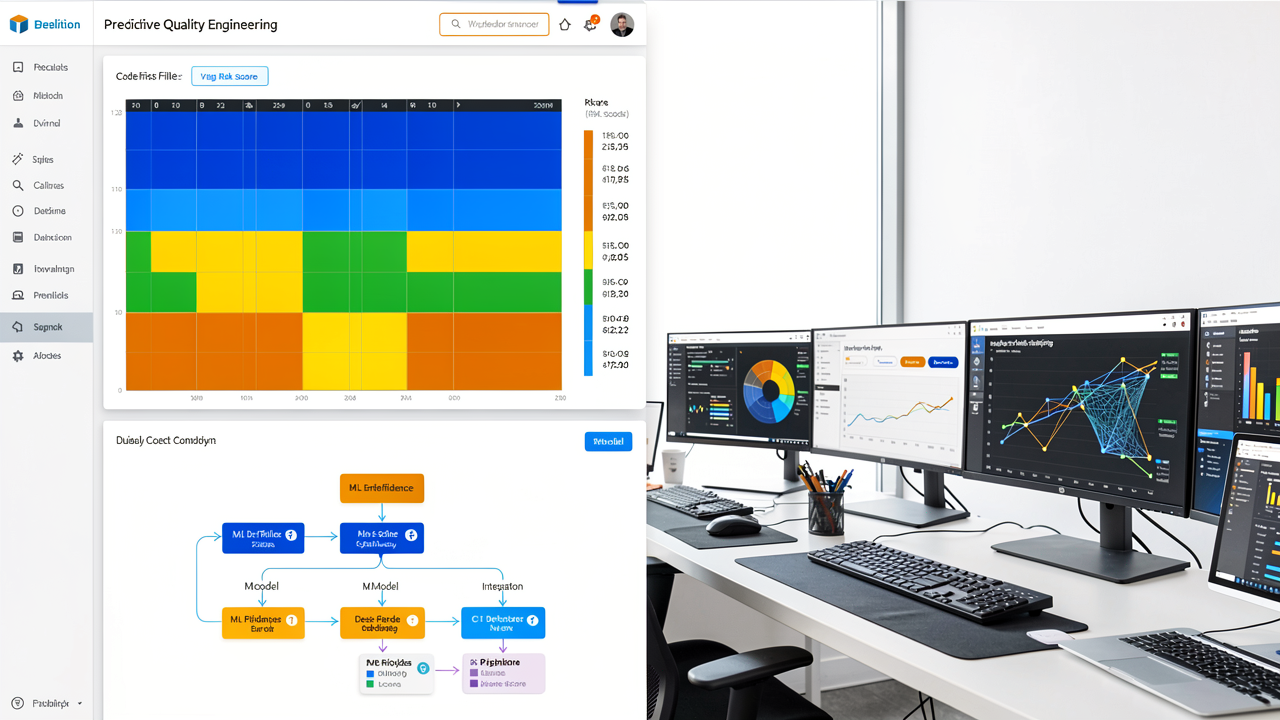
Predictive quality engineering (PQE) is the practice of using machine learning models trained on historical defect data, code churn metrics, and test failure patterns to forecast which parts of a codebase are most likely to break. Rather than treating testing as a uniform blanket effort, PQE shifts the paradigm to a risk-based approach: invest test coverage where failure probability is highest, and accept lower coverage in areas the model deems stable.
By mid-2026, several organizations have moved PQE from research papers into production CI pipelines, using signals like commit frequency, module complexity, and historical defect density to generate per-file risk scores that drive test selection and deployment gating.
Where Does the Data Come From?
A predictive quality system needs three categories of input features. The first is version control signals: how often a file changes, the number of unique authors, the size of recent diffs, and whether the file sits in a high-churn subsystem. Files that change frequently tend to accumulate technical debt and regressions at a higher rate.
The second category is test history: past failure rates per file, flakiness scores, mean time to detection, and the correlation between specific test suites and production incidents. This is often the most predictive signal — a file that has failed in CI three times in the last two weeks deserves more attention than one that hasn't been touched in months.
The third category is code quality metrics: cyclomatic complexity, maintainability index, dependency depth, and static analysis warning density. High-complexity modules with many external dependencies consistently show higher defect rates across empirical studies.
Building the Prediction Model
The simplest effective model is a gradient-boosted tree ensemble (XGBoost, LightGBM, or equivalent) trained on a labeled dataset where each training sample is a file or module, the features are the signals described above, and the label is whether the file caused a production defect or CI failure within a defined time window. The model outputs a probability score between 0 and 1.
A more sophisticated approach uses a time-aware cross-validation strategy. Because code quality patterns shift as a codebase evolves, you must train on historical data and validate on recent data — not random splits. A model trained on 2024 data and tested on 2025 data gives a realistic estimate of current predictive power. Retrain monthly to capture drift.
Feature importance analysis typically reveals that historical failure rate and commit churn are the top two predictors, followed by complexity metrics. This aligns with the intuitive observation that recently-changed, complex, flaky-code areas are where defects congregate.
Integrating PQE Into the Development Pipeline
Prediction scores are useless unless they drive decisions. Here are the three highest-impact integration points:
Intelligent test selection. Instead of running the full test suite on every commit, the CI system runs tests flagged as high-risk by the PQE model plus a baseline sampling of low-risk tests. This can reduce CI runtime by 40-60% while maintaining or improving defect detection. Tools like Blame-based test selection and Google's Test Impact Analysis follow similar principles, but PQE adds the predictive layer on top of change-tracking.
Code review prioritization. Pull requests touching high-risk files get automatically flagged for additional reviewer attention. The system can suggest reviewers who have deep context in that module based on historical ownership patterns. This doesn't replace human judgment — it surfaces the right problems to the right people faster.
Deployment gating. For high-risk services, the PQE score can be combined with test coverage thresholds and canary metrics to form a composite deployment readiness score. A service with a rising risk trend might require a longer canary window even if all tests pass, catching degradation that automated tests miss.
Common Pitfalls and How to Avoid Them
Overfitting to historical patterns. A model trained on last year's codebase may miss new failure modes introduced by architectural changes. Always validate on a recent holdout set and track model drift metrics. If the AUC drops below 0.7 on recent data, the model needs retraining or feature engineering.
Feedback loop blindness. If the PQE system only recommends tests for high-risk files, those files get more testing and fewer defects, which makes the model think they are low-risk next time. Break this loop by enforcing a minimum testing floor for all files and periodically injecting random low-risk test runs to maintain signal quality.
Ignoring developer experience. A prediction system that frequently misclassifies files will erode trust quickly. Start with a shadow mode — run the model and log its recommendations without acting on them — for at least two weeks before integrating into CI. Compare its risk rankings against your team's intuitive sense of which areas feel fragile.
Data quality debt. PQE is only as good as the signals it consumes. If your CI doesn't consistently report which tests ran and which failed, or if your version control metadata is incomplete, the model will learn from noisy labels. Audit your data pipelines before investing in model complexity.
When PQE Isn't the Right Answer
PQE shines in large, mature codebases with substantial historical data — typically 500+ engineers, thousands of commits per month, and a multi-month defect history. For smaller teams or greenfield projects, the signal-to-noise ratio is too low, and the ML pipeline overhead exceeds the benefit.
PQE should complement, not replace, foundational testing practices. It cannot compensate for missing integration tests or a culture that treats quality as a QA responsibility. The best implementations sit on top of a solid testing pyramid, not as a replacement for it.
The Road Ahead
As AI coding assistants become ubiquitous, the defect landscape is shifting. AI-generated code introduces new failure patterns — subtle logic errors and hallucinated edge cases — that historical models haven't seen. Next-generation PQE systems will need to incorporate signals about code origin and review thoroughness to maintain accuracy.
Organizations that get this right will build a feedback-driven quality culture where every defect feeds back into the prediction model, creating a virtuous cycle of continuous improvement.
Comments