
The Problem with the Generalist Approach
For years, the promise of AI seemed simple: one powerful model, one task. We'd feed a prompt to ChatGPT and expect answers to problems ranging from debugging code to writing marketing copy. It worked. Until it didn't.
Today's models are powerful, but they're still generalists trying to wear every hat in the room. The results? Slow completions on complex tasks, hallucinations creeping into critical decisions, and workarounds that make AI feel more like a spellbook than a workforce.
The Puppeteer Shift
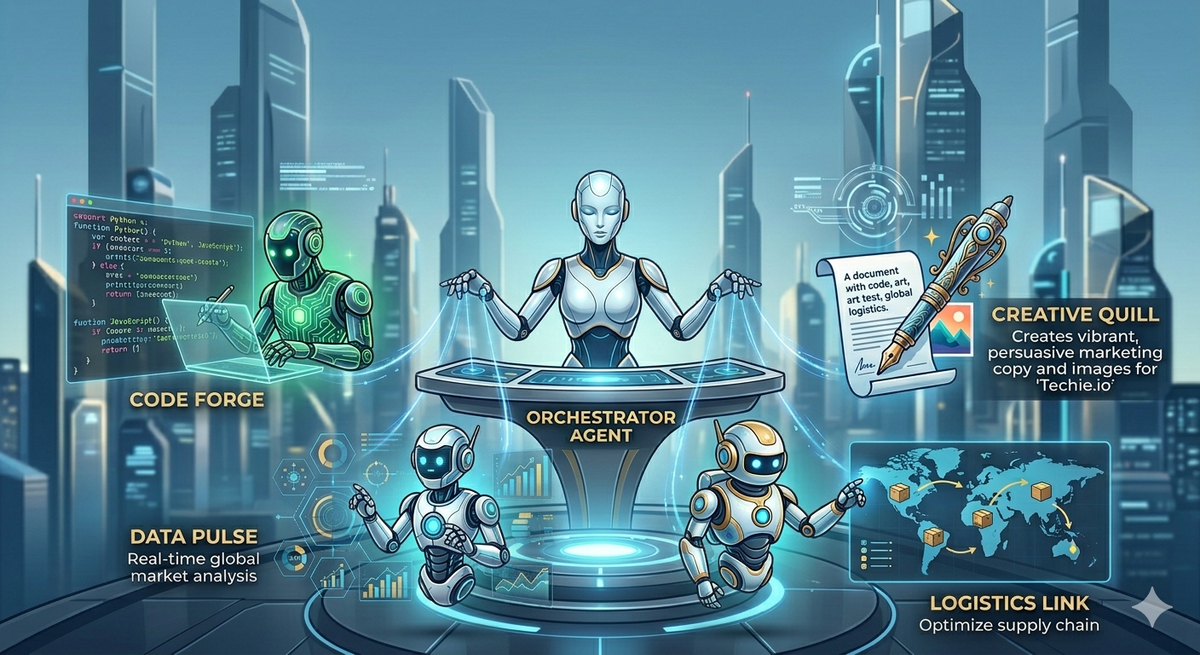
We're seeing a fundamental rethinking of how we approach AI. Rather than deploying one large LLM to handle everything, leading organizations are implementing puppeteer orchestrators that coordinate specialist agents. A researcher agent gathers information, a coder agent implements solutions, an analyst agent validates results. This pattern mirrors how human teams operate, with each agent fine-tuned for specific capabilities rather than being a jack-of-all-trades.
Why Specialist Agents Win
Efficiency Over Ambition
Generalist models optimize for versatility, which often means average performance across many domains. Specialist agents optimize for excellence in one domain. When you need deep code generation, you hand that off to an agent trained specifically on coding patterns, syntax rules, and architectural principles. When you need research synthesis, you give that to an agent fine-tuned on academic papers, industry reports, and fact-checking frameworks.
Clearer Accountability
When one model hallucinates, you're stuck. When multiple specialists collaborate, you have multiple paths to truth. If the researcher agent provides solid data but the coder agent misinterprets it, you know exactly where the breakdown occurred. This granularity makes debugging AI failures possible, something that has no precedent with monolithic models.
Parallel Execution
The most exciting development in 2026? Apps that support parallel running of tasks. While you can define a task and leave it to run in the background, the real breakthrough is starting multiple tasks simultaneously. Imagine a puppeteer orchestrator launching a research agent and a coding agent at once, waiting for their outputs to merge. The completion time doesn't just improve; it transforms.
The Engineering Implications
This architectural shift brings new challenges that didn't exist in single-agent systems:
- Inter-agent communication protocols - How do specialists share context without dilution?
- State management across boundaries - What happens when Agent A's output becomes Agent B's input?
- Conflict resolution mechanisms - What if the researcher and coder disagree on a path forward?
- Orchestration logic - How does the puppeteer know when to escalate, delegate, or terminate?
Looking Ahead
The trajectory is clear. The next decade of AI development won't be measured by the size of our models, but by the sophistication of our orchestration. The most impressive AI systems of 2026 and beyond will be those that treat AI not as a tool you command, but as a workforce you manage.
The puppeteer pattern isn't just a technical optimization. It's a recognition that we've been trying to build the wrong thing all along. Not a better generalist model. Not a smarter command interface. A workforce of specialists, orchestrated together.

Comments