

The Agentic Workforce: How Coding AI Agents Are Rewriting Software Development
Agentic AI has evolved from research curiosity to production reality. Tools like OpenEvolve, Qwen3-Coder-Next, and self-improving agents are transforming how we build, debug, and deploy software. Here's what developers need to know about the current wave of autonomous coding agents.
The Agentic Workforce: How Coding AI Agents Are Rewriting Software Development
Agentic AI has evolved from research curiosity to production reality. Tools like OpenEvolve, Qwen3-Coder-Next, and self-improving agents are transforming how we build, debug, and deploy software. Here's what developers need to know about the current wave of autonomous coding agents.
Why This Matters Now
The shift from chat-based assistants to truly agentic systems marks a paradigm change. Unlike traditional coding helpers that suggest snippets or complete functions, agentic AI can:
- Plan multi-step workflows autonomously
- Debug across systems by observing, testing, and iterating
- Self-improve by analyzing outcomes and refining their approach
- Deploy and monitor code without human intervention
Google DeepMind's AlphaEvolve demonstrated this by combining Gemini with an evolutionary algorithm that checked suggestions, picked the best ones, and fed them back to improve performance. Asankhaya Sharma soon released OpenEvolve, an open-source version accessible to anyone.
Key Models and Tools in 2026
Qwen3-Coder-Next
An 80B-parameter model released in early 2026, Qwen3-Coder-Next achieved performance near top-tier closed models while running locally on consumer hardware. It represents a critical milestone: powerful AI that doesn't require expensive cloud infrastructure.
Agentic AI Workloads
Agentic AI has experienced the most extreme gains according to Stanford's AI Index 2026. The OSWorld benchmark shows autonomous agents outperforming humans on OS-level tasks, from debugging complex system issues to deploying production systems.
The Evolution from Chat to Act
Traditional LLMs generate text. Agentic AI generates action. The difference is fundamental:
| Chat-Based | Agentic |
|---|---|
| Suggests code | Writes and runs it |
| Explains errors | Fixes and tests them |
| Needs human direction | Plans independently |
| Single task focus | Multi-step workflows |
The Technical Foundation
Self-Improvement Loops
The breakthrough came from creating feedback loops where AI systems:
- Generate solutions
- Execute them in test environments
- Analyze outcomes
- Refine their generation strategy
This evolutionary approach to AI optimization is now replicating across industries, from climate modeling to software development.
Hardware Constraints vs. Performance
The 2026 landscape shows two paths:
- Scale-up: Superchips like H200, B200, GB200 for heavy lifting
- Scale-out: Edge optimizations and quantization for smaller models
Qwen3-Coder-Next proves we don't need the first path anymore — powerful local models are now viable.
What Developers Should Build With
1. Autonomous Debugging Pipelines
Instead of manually tracing bugs, build agents that:
- Reproduce issues programmatically
- Search through logs and diagnostics
- Propose and test fixes
- Validate the solution
2. Self-Documenting Systems
Agents that not only write code but also:
- Generate architectural decisions (ADRs)
- Create documentation from behavior
- Explain trade-offs in code reviews
- Maintain technical context
3. Integration with Your Workflow
Tools like GitHub Copilot and Cursor are evolving into full agents that:
- Pull requests automatically
- Run integration tests
- Update documentation
- Deploy to staging environments
The Future Landscape
We're entering an era where:
- Software engineers need to manage AI workers
- Testing becomes automated by design
- Deployment is handled by autonomous systems
- Learning happens continuously through execution
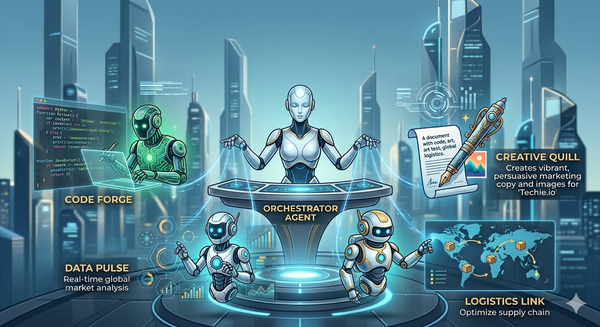
The competition in 2026 won't be on AI models themselves, but on the systems that orchestrate them. GPUs remain king, but a new class of accelerators for agentic workloads is emerging.
Takeaways
- Don't just chat with AI — build agents that act
- Design for autonomy — assume your code will be executed without review
- Measure in actions — track success by deployment outcomes, not tokens
- Expect self-improvement — your agents will get better through iteration
The work is already here. The question is: will you build with it?
Comments