
The Modular Robot Revolution: Why Your Yard Is About to Get Smarter
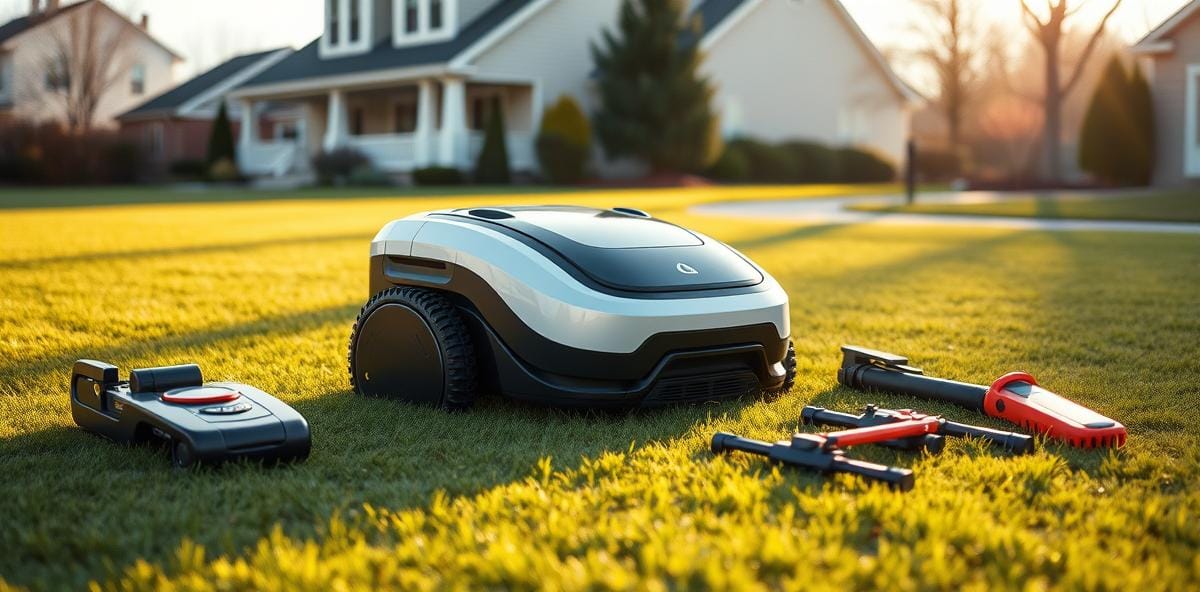
In 2026, the most interesting wave in consumer tech isn't coming from a phone or laptop. It's rolling across your lawn. The modular outdoor robot — a single robotic platform that swaps attachments to mow, clear snow, blow leaves, and trim hedges — is transforming how we think about backyard machinery. And for engineers and gadget enthusiasts alike, it represents something far bigger than convenience.
The Old Way: A Shed Full of Machines
Until recently, maintaining a yard meant owning a collection of single-purpose machines. A lawnmower. A snowblower. A leaf blower. A string trimmer. Each one costs hundreds or thousands of dollars, sits in your garage for eleven months of the year, and becomes e-waste when its battery dies or its engine seizes. The environmental and financial waste is staggering.
A typical suburban homeowner might spend $3,000 to $5,000 on outdoor power equipment — not counting fuel, maintenance, and storage space that their home no longer has room for.
The New Way: One Platform, Infinite Tools
Companies like Yarbo (which debuted the M Series at CES 2026) are flipping this model on its head. Their approach is elegant in its simplicity: build one rugged, intelligent robotic base with a standardized attachment interface, then let users swap tools season by season.
The result? A single robot that maps your property using LiDAR and visual sensors, navigates autonomously around obstacles, and switches between tasks depending on which attachment is mounted. Spring comes — swap to the mowing module. Autumn arrives — swap to the leaf blower. Winter rolls in — swap to snow clearing. The hardware stays; the capability changes.
How It Actually Works
Modern modular outdoor robots rely on three core technologies that converged to make this possible:
- Autonomous navigation without boundary wires. Early robot mowers used buried perimeter wires — a nightmare for installation and a pain for anyone who wanted to rearrange their garden. New models like the Dreame E18 use front-facing cameras and onboard AI to map spaces in real time. You unbox it, let it spin in a circle for thirty seconds, and it knows your yard.
- Standardized power and data interfaces. The trick isn't just building one robot — it's making every attachment talk to the base the same way. Magnetic pogo pins handle power delivery; a simple serial protocol handles control signals. Swap a tool in seconds, and the robot reconfigures itself automatically.
- Modular battery architecture. These robots don't rely on a single massive battery pack. Instead, they use swappable modular cells that can be charged individually or in parallel, dramatically extending runtime and simplifying replacement.
The Bigger Picture: Why Engineers Should Care
This isn't just about lazy homeowners. The modular robot platform is a masterclass in systems engineering for anyone building physical products:
- Unit economics improve with scale. Rather than manufacturing and warehousing four different machines, you manufacture one base at higher volume and many simpler attachments. Tooling costs drop; inventory complexity plummets.
- Software becomes the product. The robot's navigation AI, path-planning algorithms, and seasonal scheduling are where real value accumulates. Hardware commoditizes; software differentiates.
- The attachment marketplace creates recurring revenue. Once you have a user base locked into your platform, every new attachment is essentially pure profit — low manufacturing cost, high perceived value.
- Sustainability is genuinely measurable. Fewer machines means fewer raw materials, fewer batteries ending up in landfills, and zero gasoline emissions. This isn't greenwashing; it's arithmetic.
The Competitive Landscape
The space is heating up fast. Traditional players like Husqvarna and Stihl are scrambling to adapt their dealership models. Chinese manufacturers like Dreame and Ecovacs are pushing aggressively on price and sensor quality, leveraging their experience from the robot vacuum market. Startups like Yarbo are betting everything on modularity as the moat.
Meanwhile, established mower brands face an existential question: what happens when your product becomes a one-time transaction? Modular robots turn that model into a platform play — and platform plays win markets.
What's Coming Next
The next wave will likely bring robotic platforms beyond the yard entirely. Imagine a modular base that swaps between garden weeding, pool cleaning, and even security patrol modes. The same philosophy that makes sense for your lawn — one intelligent body, many specialized tools — applies to countless outdoor and semi-outdoor domains.
We're also seeing the early stages of fleet intelligence. When thousands of these robots map millions of yards, the aggregated data on soil conditions, microclimates, plant health, and seasonal patterns becomes incredibly valuable. Think of it as the Internet of Things, but for your neighborhood's dirt.
Should You Buy One?
If you have a yard larger than a postage stamp and zero desire to push a machine around it, yes — absolutely. The technology has matured rapidly in 2025 and 2026, with models like the Ecovacs Goat A3000 LiDAR Pro and Dreame's OmniSense-equipped robots proving reliable on real-world terrain, not just flat test gardens.
If you're a developer or engineer, watch this space closely. The convergence of affordable LiDAR, edge AI inference, and modular hardware design is creating opportunities that extend far beyond landscaping. The companies that crack platform strategy in outdoor robotics will build something worth paying attention to.
The future of consumer tech isn't just about faster processors or higher resolution screens. It's about machines that do actual work in the physical world — intelligently, sustainably, and without you lifting a finger. Your yard is already smarter than you think. It just didn't have the right robot yet.
Comments