
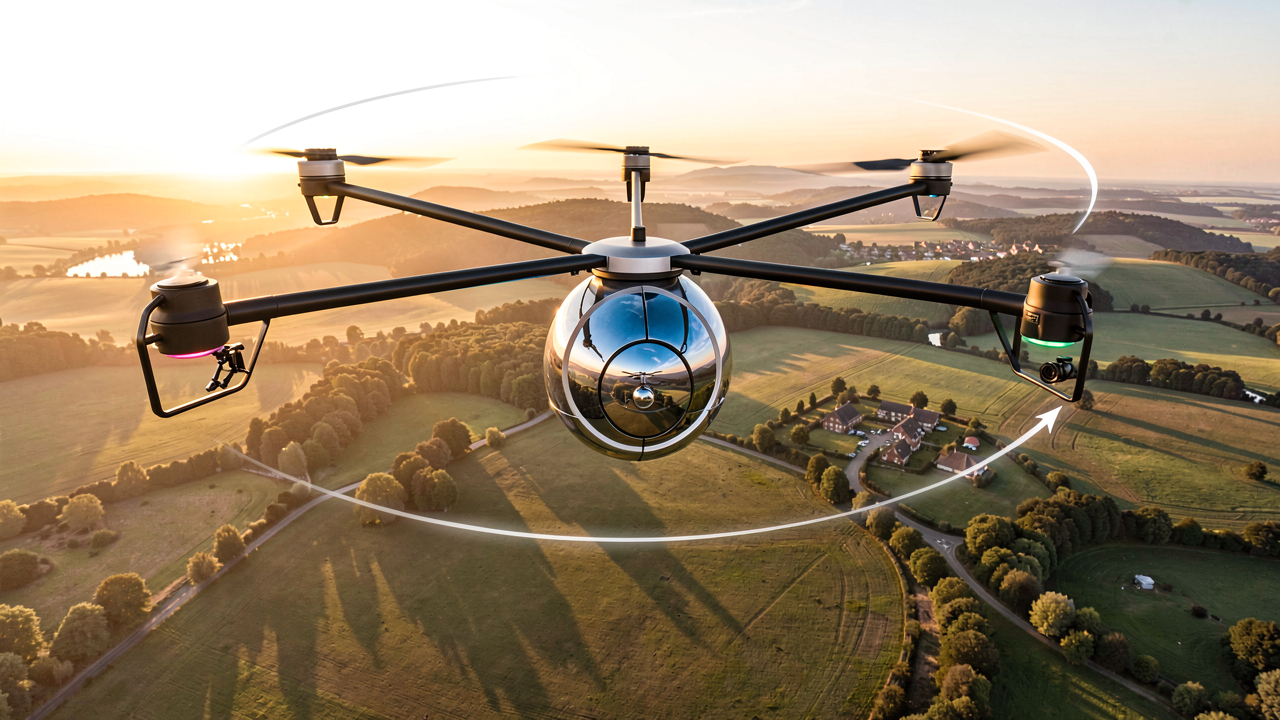
The 360-Degree Revolution: How Post-Capture Reframing Is Reshaping Drone Videography in 2026
The most significant shift in aerial videography isn't about bigger sensors or faster processors — it's about letting go of the frame entirely. In 2026, 360-degree drones have moved from novelty to necessity, and the workflow they enable — "shoot first, frame later" — is fundamentally changing how creators think about aerial footage. This isn't just a incremental improvement; it's a complete inversion of the traditional cinematography pipeline.
From Precision Piloting to Creative Reframing
For decades, aerial videography demanded a rare combination of skills. You needed FPV piloting expertise to execute smooth, cinematic maneuvers, precise spatial awareness to avoid obstacles, and an almost premonitory sense of where the subject would be three seconds from now. One wrong stick input and your shot was ruined. The margin for error was razor-thin, and the learning curve was steep enough that most creators never crossed it.
360-degree drones flip this entire paradigm. Devices like the Insta360 X5 (which doubles down on 8K 360-degree capture with AI-powered reframing) and the Antigravity A1 — unveiled at NAB 2026 with a dual-lens system recording full spherical imagery in real time — capture everything around them simultaneously. The drone itself is computationally removed from the frame through proprietary stitching algorithms, creating what feels like an invisible camera floating through space.
The result? You no longer need to pilot precisely. You fly the drone to a general location, let it capture the full 360-degree sphere, and then — critically — you compose the shot after landing. This "shoot first, frame later" approach transforms aerial videography from performance art into editorial craft.
The Technical Architecture Behind Invisible Cameras
Understanding why this works requires understanding the equirectangular projection that underpins all 360-degree capture. Unlike traditional cameras that record a rectangular slice of the visual field, 360 cameras capture a complete sphere — 360 degrees horizontally and 180 degrees vertically — mapped onto a 2:1 rectangular canvas. This distortion-heavy format is the price paid for omnidirectional coverage.
Modern stabilization systems handle yaw and tilt with remarkable smoothness, but the real magic happens in post-production. Reframing tools extract standard 16:9 or vertical clips from the same master file, effectively giving you unlimited camera angles from a single recording. The DJI Avata 360 extends this further with built-in simulation tools that let you rehearse rolls and clever piloting tricks in software before executing them in flight — or simply let the software generate them for you.
The Antigravity A1 takes a different approach. Its dual-lens system — one facing up, one facing down — records a full spherical image stitched in real time, eliminating the propeller-shadow problem that plagued earlier 360-degree drones.
Production Workflow Implications
The shift to post-capture reframing has profound implications for production workflows. Traditional aerial videography follows a linear path: plan the shot, execute the flight, review the footage, reshoot if necessary. With 360 drones, the workflow becomes iterative and exploratory. You capture broadly, then compose narrowly.
This has several practical consequences. First, it dramatically reduces the cost of mistakes. A pilot who drifts too close to an obstacle or misses the optimal angle can simply reframe from the captured sphere. Second, it enables creative discoveries that would be impossible with traditional cameras — you might capture a sweeping landscape that later reveals a hidden detail when you zoom into a specific region of the frame. Third, it compresses shoot timelines significantly, since the "perfect shot" is no longer dependent on perfect execution in a single pass.
However, the workflow isn't without its challenges. Stitching artifacts still appear occasionally in exported video, particularly in high-contrast scenes or during rapid camera movements. The file sizes are substantial — an 8K 360-degree recording consumes storage at a rate that demands careful card management on location. And while AI-powered reframing has become remarkably sophisticated, it still requires editorial judgment to produce genuinely cinematic results rather than technically competent ones.
Market Dynamics and Competitive Landscape
The 360 drone market in 2026 is shaped by an unusual competitive dynamic. Insta360, traditionally a ground-based 360-camera company, has entered the drone space with the Antigravity A1, challenging DJI's dominance through a philosophy centered on 360 capture and post-production reframing rather than competing on sensor size or lens diversity. Meanwhile, DJI has responded with the Avata 360, bringing its piloting expertise and ecosystem integration to the same paradigm.
This competition drives rapid innovation. The Antigravity A1's real-time stitching and invisible-camera approach represents a fundamentally different design philosophy from the Avata 360's simulation-assisted model. Both converge on the same insight — the future of aerial videography lies in decoupling capture from composition — but arrive there through different engineering paths.
What This Means for Creators
For content creators, the 360 drone revolution means that the barrier to cinematic aerial footage has never been lower. You no longer need years of FPV training to produce compelling aerial shots. You need a drone, a destination, and the editorial sensibility to find the story within the sphere. The technology handles the precision; you handle the vision.
The broader implication is a democratization of aerial cinematography that mirrors what happened to photography with smartphones. Just as mobile cameras put high-quality imaging in everyone's pocket, 360-degree drones are putting cinematic aerial capabilities in everyone's hands — with the caveat that capability still requires creative judgment. The camera can capture everything, but it can't decide what matters. That part is still up to you.
The "shoot first, frame later" paradigm isn't just a new technique — it's a new way of seeing. By capturing the entire world around the drone and deferring composition to post-production, creators are freed from the tyranny of the pre-visualized shot. The result is footage that feels more exploratory, more discovery-driven, and ultimately more alive than anything produced through traditional precision piloting alone.
Comments