
Why Model-Free Parsing Is Quietly Winning RAG
For years, the default answer to "how do I get a PDF into my LLM?" was to throw tokens at it. Vision-language models like LlamaParse and Docling can read pages beautifully — but they cost real money per page, need GPUs or cloud APIs, add latency measured in seconds, and quietly leak your documents to third-party services. That trade-off made sense when parsing quality mattered more than speed. Then LiteParse 2.1 arrived: a fully open-source, model-free PDF-to-Markdown parser that runs at roughly three milliseconds per page on a laptop CPU.
This is the story of why "no model" became a feature — and how dropping the LLM from your ingestion layer changes everything downstream in a RAG pipeline. It is not about replacing vision models wholesale; it is about knowing when a deterministic parser is the better engineering answer, and when you still need the eyes.
What LiteParse Actually Does
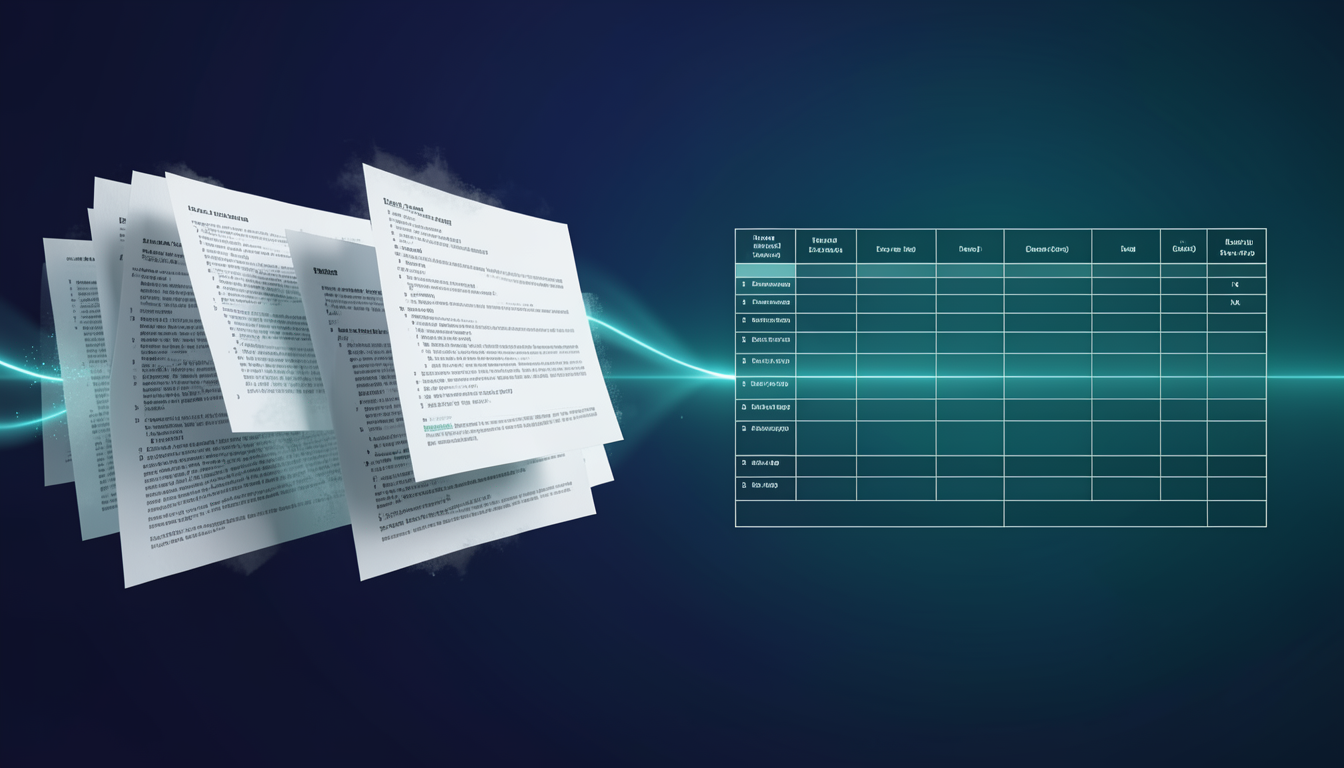
LiteParse reads documents by reconstructing their spatial layout into Markdown — headings, tables, lists, images, links — using only geometry. It combines two signals to do this:
- A custom PDFium fork that captures as much raw signal from the PDF rendering engine as possible.
- A grid-projection algorithm that maps text coordinates and font sizes onto a logical layout grid, then translates those visual signals directly into Markdown elements.
The result is a purely heuristic, rule-based parser. No neural network weights are loaded, no GPU is touched, no cloud endpoint is called. You drop in any document — PDF, DOCX, PPTX, XLSX, or an image — and it auto-detects the format and selects the right parsing strategy.
The Numbers That Matter
Benchmarks against text-extraction libraries rather than vision models tell a more honest story. Comparing to PyPDF, PyMuPDF, and Markitdown — tools that do similar jobs without VLMs — LiteParse comes out ahead on layout fidelity while staying dramatically cheaper than an LLM call:
| Approach | Model Required | Latency per page | Cost model |
|---|---|---|---|
| VLM parser (LlamaParse, Docling) | Yes — GPU/cloud | Seconds | Per-page token fees |
| Classic text extractors | No | Milliseconds | Free / local |
| LiteParse 2.1 | No | ~3 ms/page | Free, fully open source |
The latency and cost wins compound quickly at scale. Ingesting a hundred thousand pages through a VLM costs real money and hours of GPU time; the same corpus through LiteParse is effectively free and finishes in minutes on ordinary hardware.
Why "No Model" Is a Feature for RAG
The obvious benefit is cost, but there are three quieter wins that matter more in production:
- Data privacy. Because nothing leaves your machine, LiteParse fits naturally into air-gapped or regulated environments where shipping documents to an OCR API was previously a blocker. On-premise parsing becomes the default rather than an exception.
- Determinism and testability. A rule-based parser is deterministic: parse the same PDF twice and you get byte-identical output. That makes golden-file tests, regression suites, and CI gates meaningful — something a stochastic VLM can never offer reliably.
- Token economy in the ingestion loop. The real cost of parsing isn't just the parser call; it's that every downstream LLM interaction re-reads your extracted text. Cleaner Markdown means cleaner embeddings, smaller context windows, and fewer wasted tokens across retrieval and generation.
Where You Still Need a Vision Model
Model-free parsing is not magic. It reconstructs structure from layout signals — which works beautifully for clean digital PDFs, invoices with well-defined grids, and text-heavy slides. But it struggles where meaning lives in the pixels rather than the geometry: handwritten scans, heavily degraded documents, complex multi-column scientific figures, or anything requiring true visual understanding.
LiteParse is not trying to benchmark against VLM-based tools. The team's own documentation makes this explicit — they compare only against basic text-extraction libraries because that is the honest peer group for a model-free parser.
The pragmatic pattern emerging in 2026 is a cascade: try deterministic parsing first, measure confidence (font coverage, table detection success), and escalate to a VLM only on failure. Most documents never reach the expensive tier — which is exactly how you keep ingestion costs flat while your corpus grows.
Practical Adoption Patterns
LiteParse ships as a Python package, an @llamaindex/liteparse npm package for Node developers, and a Rust crate plus in-browser WASM build. That breadth matters: it means the same parser can run server-side, inside an edge function, or directly in the browser without any model download.
A sensible production wiring looks like this:
# Parse locally into Markdown — no API call
from liteparse import parse_document

markdown = parse_document("invoice.pdf")
chunks = chunk_for_rag(markdown)   # your own splitter
The key engineering move is to treat parsing as a pure function with explicit failure signals. Wrap the parser so that low-confidence output routes to a vision model, high-confidence output flows straight into your embedding pipeline, and everything gets logged for future regression tests.
The Bottom Line
Model-free document parsing won't retire vision-language models — but it will stop them from being the default. For the enormous slice of documents that are structurally legible, a three-millisecond deterministic parser beats a seconds-long VLM call on every axis that matters at scale: cost, privacy, determinism, and testability.
The winning RAG pipelines of 2026 will not be built around "throw more tokens at it." They will route each document to the cheapest tool capable of handling it — and let the expensive eyes stay in reserve for the pages that genuinely need them. That is the quiet revolution LiteParse represents, and it is worth a place in your ingestion toolkit.
LiteParse 2.1 was released by LlamaIndex on June 20, 2026 as open-source software under permissive licensing. It renders documents directly to Markdown for LLM and RAG pipelines without GPU or cloud dependency.
Comments