
Thunderbolt 5 Doubles the Pipe but Not the Lane to Your GPU
ASUS announced the ROG XG Station 3 on November 3, 2026, an external graphics dock built around Thunderbolt 5. The headline number is the easy one to misread. 80 Gbps sounds like the GPU just got twice as much road, and the launch coverage repeats the figure as if the eGPU performance tax finally evaporated. It did not. The dock is interesting for a different reason, and that reason hides in one spec line ASUS put in a table instead of a bullet.
What it actually is
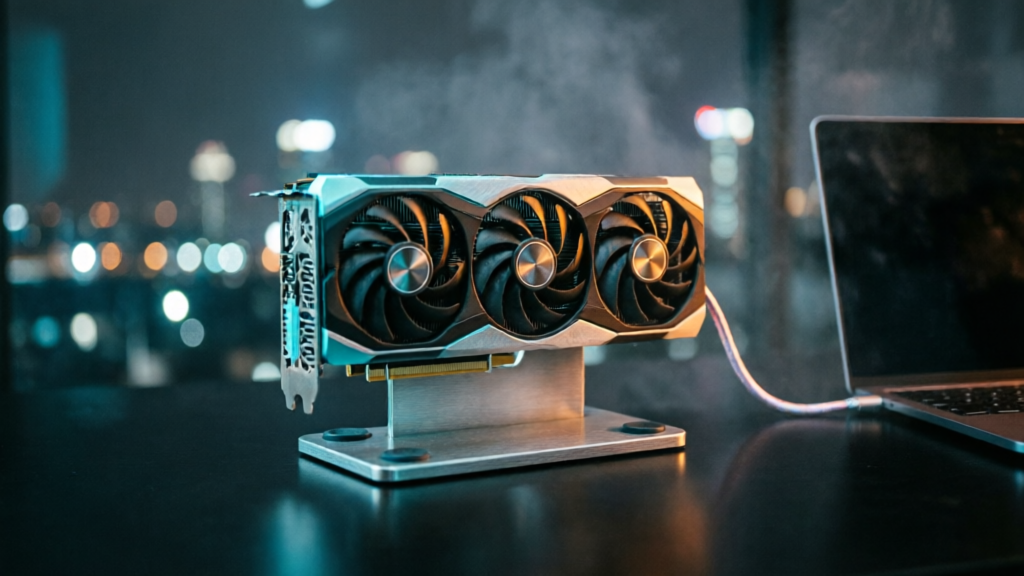
The XG Station 3 is not a box. It is a flat metal base with a PCIe slot on it, an open-frame design that leaves the graphics card sitting exposed on your desk. ASUS pitches this as aesthetics, and the card-as-centerpiece reading is fair, but the thermal argument is real: nothing blocks the cooler, so boost clocks hold under load. The downside is equally real. You now own a dust collector with a flagship card on it, and cats have opinions.
The specs, per ASUS's press release and product page:
- Thunderbolt 5 upstream to the laptop, up to 80 Gbps bidirectional, with a 120 Gbps one-direction Bandwidth Boost mode reserved for video traffic
- The PCIe tunnel is PCIe 4.0 x4, roughly 64 Gbit/s of raw lane for the graphics card
- Up to 140W of Power Delivery back to the laptop over the same cable
- A downstream Thunderbolt 5 port with 36W, supporting daisy-chained displays, up to three 4K monitors in ASUS's phrasing
- Two front USB-C ports at 10 Gbps, Aura Sync RGB, and no HDMI or DisplayPort on the dock itself, since the installed card provides those outputs
- GPU ceiling of 361 x 139.3 x 93.9 mm, which clears an RTX 5090 with its triple-fan brick
- A GC-HPWR slot, the first XG Station to support ASUS BTF cards, which draw power through the slot and leave no visible 16-pin cable
- No power supply in the box. Bring your own SFX or SFX-L unit, 750W 80 Plus Gold or better recommended
- Windows 11 25H2 or later. No macOS support at all
ASUS has not announced a price or a ship date, though retailer listings circulating around $2,199.99 suggest the ballpark. That figure buys the base, the ports, and a one-meter cable. Not the GPU. Not the PSU.
The spec line that matters
Thunderbolt 5 doubles the pipe, from 40 to 80 Gbps, but the XG Station 3 still hands the graphics card a PCIe 4.0 x4 tunnel. That is the same lane width the Thunderbolt 4 generation used. The controller family behind the current dock wave, Intel's JHL9480, is a PCIe 4.0 x4 device, and the cheaper Thunderbolt 5 enclosures that flooded the market this year, the Aoostar EG02 at $219, the Minisforum DEG2 around $300, the EXP GDC TH5P4, all expose the same lane.
Doubling the pipe buys room for everyone else on the cable. A Thunderbolt link is shared: the GPU stream, the display stream, storage, and peripheral traffic all ride the same wire. At 40 Gbps those flows fought each other, and a busy desk could starve the card. At 80 Gbps the PCIe lane fits inside the pipe with headroom for three 4K monitors and an external SSD at the same time. The cable stops being a competing consumer. The GPU's bandwidth ceiling, though, is set by the lane, not the pipe.
This is where the developer angle gets genuinely interesting, because the workload decides how much the lane ceiling hurts. In gaming, the link is on the hot path constantly: frames cross it every refresh, and the historical eGPU performance loss lives right there. Local LLM inference is the opposite shape. Loading a 17GB quantized model across a lane that moves a few gigabytes per second costs a handful of seconds, once, at session start. After that the weights live in VRAM and the link carries almost nothing. Structurally, a dock is the worst possible attach method for the workload that cares least about attach bandwidth. If your actual goal is a desktop GPU for running 27B-class models overnight next to a Thunderbolt 5 laptop, the PCIe 4.0 x4 ceiling is a rounding error, and the eGPU market has quietly become a cheap path to 32GB of VRAM on a machine with no PCIe slot.
The counterweight is the market those cards live in. GPU street prices climbed again in October, with RTX 5090 cards touching $9,400 in the US, and the same memory shortage that pushed DDR5 kits to five times their 2025 price is squeezing board supply too. Gigabyte sells a prebuilt Thunderbolt 5 box with a water-cooled RTX 5090 inside for $3,700, which tells you the enclosure was never the expensive part of an eGPU. The dock is the cheap third of the equation. The card is the mortgage.
Who should actually buy one
The honest candidate is someone with a Thunderbolt 5 laptop who wants one machine: slim on the go, desktop-class at the desk, monitors and peripherals all folding into the same single cable. The 140W delivery covers ultrabooks and most all-round laptops, though a gaming laptop expecting 240W or 330W still needs its own brick under load, which undercuts the single-cable story at exactly the desk where it matters.
Skip it if you already own a gaming laptop with a capable mobile GPU, since the marginal gain over your internal chip is small next to the cost. Skip it on a Mac, full stop: the XG Station 3 lists Windows 11 25H2 and nothing else. And hold off until independent benchmarks land, because ASUS shipped a spec sheet, not measurements. Every generation of external GPU arrives claiming this time there is no penalty. There was always a penalty. The question is only how big and where it moved.
What to watch for
Three things will decide whether this generation is different. First, whether a Thunderbolt 5 dock with a PCIe 5.0 x4 tunnel ships, since the current controllers are the lane bottleneck and not the cable. Second, whether independent testers publish token-throughput and model-load numbers alongside frame rates, because the inference crowd reads the link completely differently from the gaming crowd and today's reviews only measure one of them. Third, whether the card market ever returns to prices that make an eGPU experiment feel like an experiment instead of a down payment.
The XG Station line dates to 2007, which makes it one of the longest-running "this is the year external GPUs work" franchises in PC hardware. Thunderbolt 5 did not end that story. It made the cable irrelevant so the remaining constraints, the lane width, the card price, the missing power supply, could finally take the blame in full view. That is real progress, just quieter than the launch copy. I keep thinking the most useful version of this device is not in ASUS's marketing at all: not a gaming dock, but a sleeping inference box you bolt to a work laptop, which is the one workload where the doubled pipe and the unchanged lane stop mattering at the same time.
Comments