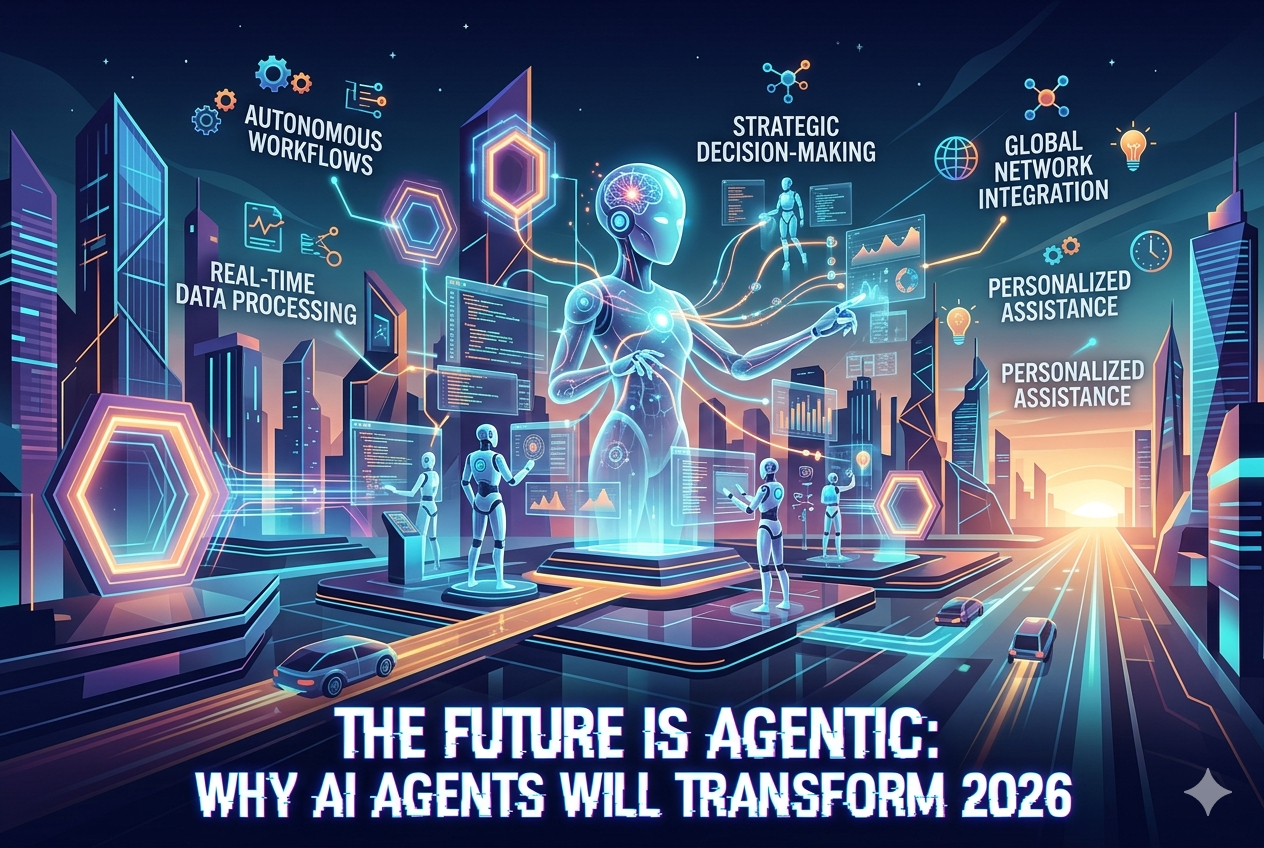
The Future is Agentic: Why AI Agents Will Transform 2026
The AI hype cycle of 2025 left many in the "trough of disillusionment." Generative AI tools became ubiquitous, yet few saw the transformative spark. Enter 2026, where the real revolution begins: **agentic AI**.

The AI hype cycle of 2025 left many in the "trough of disillusionment." Generative AI tools became ubiquitous, yet few saw the transformative spark. Enter 2026, where the real revolution begins: agentic AI.
Beyond Chatbots
The fundamental shift isn't about better text generation—it's about action. While generative AI chatbots could draft emails and summarize documents, AI agents can now execute end-to-end workflows.
At MIT, researchers describe agentic AI as systems that "perceive, plan, act, and learn." Unlike traditional chatbots that wait for explicit prompts, agents autonomously execute multi-step tasks with memory, tool access, and adaptive reasoning.
The 2026 Reality
Microsoft's latest analysis highlights seven trends defining AI's next chapter:
- Agentic automation replacing manual workflows
- Interoperable agents breaking vendor lock-in
- Hardened governance with security-audited releases
- AI-driven cybersecurity at enterprise scale
- Autonomous robotics in manufacturing
- Massive infrastructure investments (billions for data centers)
- ROI-focused adoption demanding immediate value
Amazon's millionth robot, coordinated by DeepFleet AI, exemplifies this shift—improving warehouse efficiency by 10% through autonomous decision-making.
Why It Matters
The business case is compelling:
- Faster time-to-value: Companies demand immediate ROI, not years of R&D
- Rapid prototyping: Accelerated product development cycles
- Human augmentation: Pair programming with AI agents
- End-to-end automation: From scheduling to execution
The Architecture Shift
According to Stack AI's 2026 guide, workflow architecture now matters more than ever. The key questions:
- How much autonomy should agents have?
- What happens when things go wrong?
- How do we ensure safety at scale?
Oracle's recent AI Agent Studio updates answer these with capabilities for "workflow orchestration, content intelligence, contextual memory, and ROI measurement."
Looking Ahead
The next decade won't just be about AI—it'll be about agency. Systems that think, plan, and act will reshape industries from healthcare to logistics. The organizations that thrive will be those that learn to work with agentic AI, not against it.
The question isn't whether AI will become agent-based—it already is. The question is: are you ready?