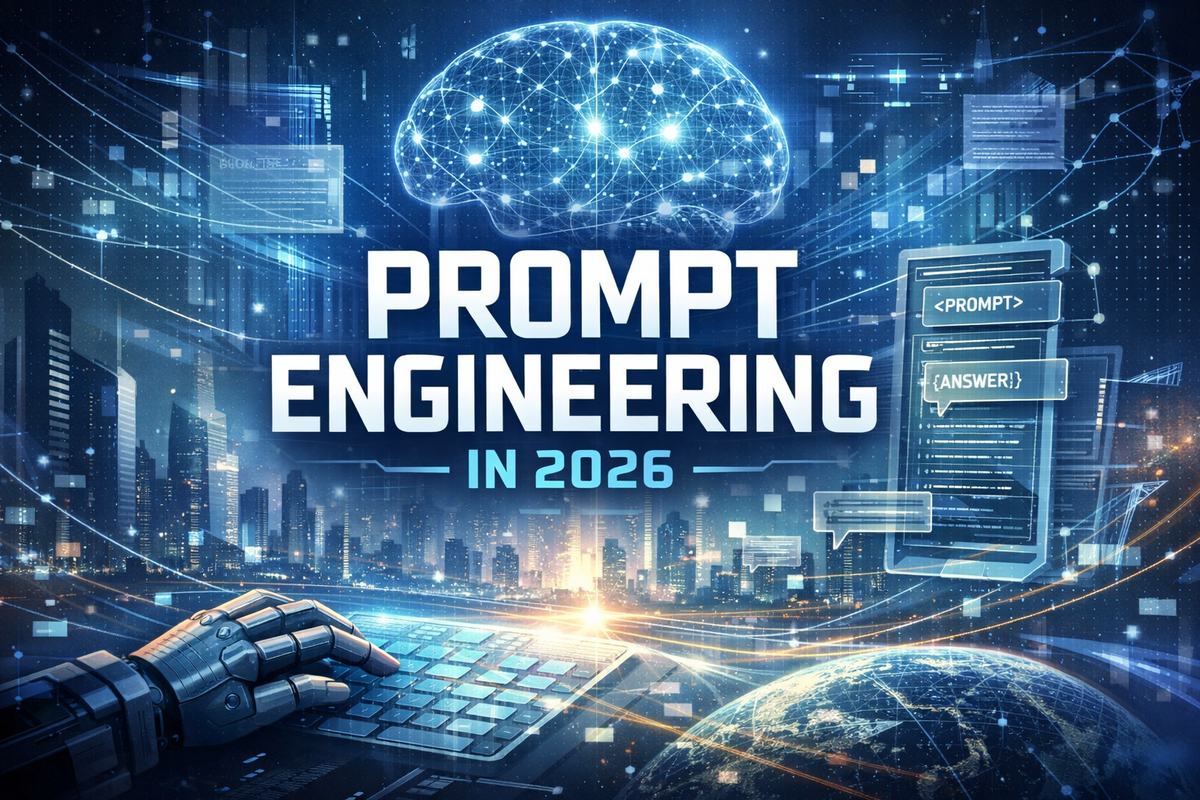
Prompt Engineering in 2026: The Skills That Actually Matter
In 2026, the conversation has moved beyond "how do I write a better prompt?" to "how do I design systems that work with AI agents autonomously?"

The Great Pivot
In 2023, "prompt engineering" was the buzzword of the decade. We were all obsessed with finding that perfect prompt, crafting our golden questions to coax AI into spitting out exactly what we wanted. It was impressive work, sure, but it was just the warm-up.
By late 2024, we started noticing something strange. The best prompts were becoming harder to find. The AI was getting smarter at figuring out what we needed, even when we weren't being super specific. And then came 2025, and the landscape shifted completely.
Today, in 2026, the conversation has moved beyond "how do I write a better prompt?" to "how do I design systems that work with AI agents autonomously?"
From Single Shots to Multi-Agent Workflows
The old days of single-shot prompting are largely a relic now. Sure, you can still use isolated prompts for quick tasks, but the real value is in orchestration.
The prompt engineering of 2026 isn't about finding the perfect one-shot prompt anymore. It's about:
- Designing clear agent protocols that specify roles, goals, and handoffs
- Creating multi-agent workflows where specialized agents collaborate
- Building feedback loops that allow agents to self-correct
- Establishing context management systems that preserve information across iterations
Think of it less like prompting and more like software architecture. You're not writing a request to a function; you're designing a system of functions that talk to each other.
The New Skill Stack
If you're building your career for 2026, here's what you should be focusing on:
1. Agent Orchestration Design
This is the new frontier. You need to be able to:
- Define clear agent roles and responsibilities
- Design handoff protocols between agents
- Create feedback mechanisms for agent collaboration
- Handle failure modes and recovery strategies
2. Prompt Quality Control
The prompt of 2026 is about consistency and reliability, not just cleverness. You need to:
- Ensure prompts work across different agents and contexts
- Create fallback mechanisms for when prompts fail
- Build in human-in-the-loop validation points
- Measure and track prompt effectiveness
3. Context Engineering
The ability to manage and manipulate context is super important. This includes:
- Summarization for long contexts
- Pruning irrelevant information
- Creating context hierarchies
- Managing agent memory and state
The Practical Takeaway
The "best prompt" in 2026 is the one that fits into a robust, multi-agent system. It's not about the magic bullet. It's about building systems that can:
- Handle ambiguity gracefully
- Self-correct when things go wrong
- Collaborate across specialized functions
- Evolve and adapt over time
What This Means for You
If you're an individual contributor: Focus on learning how to integrate AI agents into your existing workflows. The skill that separates good AI users from great ones is the ability to design robust, multi-stage processes that use multiple AI capabilities.
If you're building a career in AI: Stop thinking about "prompt engineering" as a standalone skill. Start thinking about agent systems design — the ability to architect workflows that leverage multiple AI agents working together.
The field of "prompt engineering" hasn't disappeared; it's evolved into something much more complex and powerful. And if you want to be at the cutting edge in 2026 and beyond, you need to be ready to think about systems, not just prompts.