
NVIDIA PAIR turns idle home PCs into a 2x faster local agent cluster
Run any local agent setup for more than a week and you hit the same wall. A coding agent spawns subagents, one reviewing a diff, another writing tests, a third summarizing docs, and every inference request queues behind one GPU. The desktop next to you, the one with an RTX 3080 that only earns its keep during Steam sales, contributes nothing. The bottleneck is not inference speed. It is that the software assumes one machine.
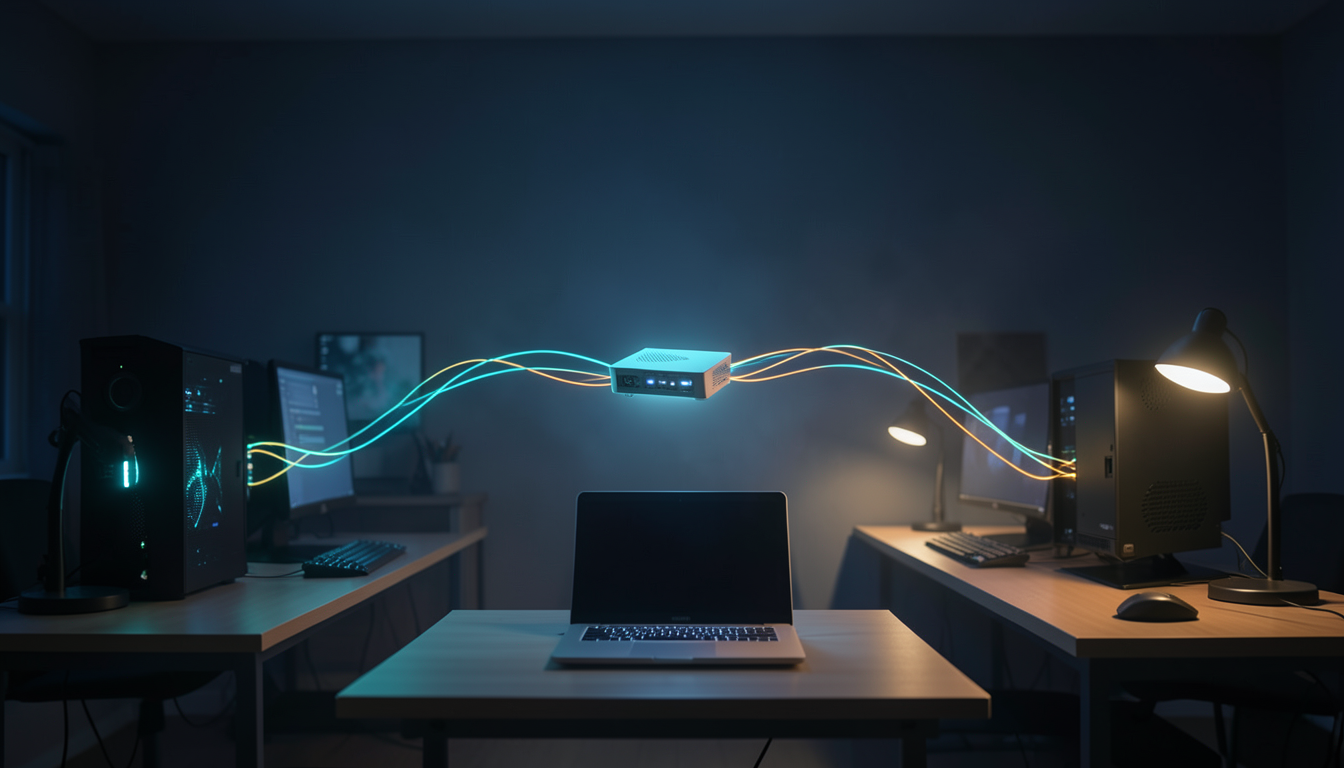
NVIDIA released a free public beta this week at IFA 2026 that attacks that specific problem. Personal AI Router, or PAIR, discovers compatible machines on your local network and spreads independent inference requests across them. It is Apache 2.0 open source, it speaks to Ollama and LM Studio, and it treats Apple Silicon as a first-class citizen. One constraint shapes everything else: PAIR routes whole requests. It never splits a model.
Routing jobs, not splitting models
PAIR does job-level distribution. One request goes to one machine. A 30 GB model will not fit across three 10 GB GPUs, and every node that accepts a request has to be able to serve that model entirely by itself. This is not tensor parallelism, and no amount of keynote gloss changes what the code does.
The scheduler picks a node per request using queue depth, live GPU utilization, engine state, and whether the requested model is already loaded. Nodes do not need identical models: different machines can host different tags and PAIR routes according to model location, and loading the same tag on more nodes gives that request class a bigger eligible pool.
The support list is broader than you would expect from NVIDIA: GeForce RTX 20-series and newer, RTX PRO workstation cards back to Turing, DGX Spark, and Apple M4 and later silicon, across Windows, macOS, and Linux. NVIDIA shipping software that happily routes inference traffic into a fleet of MacBooks is a new world, and it is what makes a mixed-device household cluster actually workable.
The numbers, and what they do not mean
NVIDIA's published demo ran five subagents through Hermes Desktop against Ollama. On a single RTX Spark laptop the workload took 18 minutes. On a three-device PAIR cluster it finished in 8 minutes 48 seconds, just over 2x. It is a vendor benchmark from a chosen demo, so treat the magnitude with suspicion. The shape of the result is honest though: routing helps when genuinely independent requests are in flight, and a three-machine pool recovers most of the serialization you were paying for.
The corollary: a single sequential chat request gets nothing from PAIR because there is nothing to route. If your local AI usage is one question at a time, you are adding a proxy hop and background services to babysit for zero gain.
It slots under what you already run
The integration trick is simple and smart. PAIR takes over the default port your inference tool already listens on, 11434 for Ollama, and proxies requests to whichever machine fits each one best. Agent harnesses and any app with a configurable base URL keep pointing at localhost and never learn the difference. No new API to adopt, no harness changes.
# Single machine: everything queues behind one GPU
ollama serve                # listens on localhost:11434

# With PAIR: the router owns that port, agents change nothing
OPENAI_BASE_URL=http://localhost:11434/v1

# Requests fan out to the RTX desktop, the M4 laptop, the
# spare Linux box: anywhere the model is loaded and free
Joining a cluster is deliberately manual in the way good local tooling should be. You invite a machine, a six-digit PIN appears, you type it on the joining machine, and mTLS encrypts cluster traffic from then on while mDNS handles discovery. It reads like the HomeKit pairing flow applied to cluster tools, which is the right instinct for software aimed at home networks instead of data centers.
Where it breaks down
Know the limits before installing on three machines. Each participating box needs enough memory and compute for whatever model it is assigned, so a router does not rescue hardware that could not run the model alone. Model load time still happens per node, and cold starts hide in the tail of your latency numbers. The scheduler is beta-grade, working from queue depth and utilization today with richer signals promised later. And while prompts, files, and agent context stay on your network, every machine you invite becomes one receiving your agent context over Wi-Fi, so think about which box gets in.
Architecturally, PAIR sits between the single-PC setup most people have and a Ray-and-vLLM production cluster. Anyone who has stood up a real inference cluster knows the operational tax of the second option: pinned versions, head-node babysitting, YAML for everything. PAIR replaces that with a desktop app and a pairing PIN, and for the target workload of parallel calls against quantized models, that trade is clearly correct.
The timing is the story
PAIR did not land this week by accident. NVIDIA's RTX Spark machines, a Grace ARM CPU fused with a Blackwell GPU and up to 128 GB unified memory, ship this fall from ASUS, Dell, HP, Lenovo, and Microsoft, and a single Spark box runs a 120-billion-parameter model locally. A couple of those, plus the gaming PC idle since the last sale, can serve a whole household of agents, and PAIR is the thing that makes a second and third AI box more than a spare. The bet baked into the software is that heterogeneous local fleets, not single wonder-machines, are where consumer inference ends up.
Nothing about a router makes one model run faster. It stops your setup from pretending the house contains only one computer. If your agent work already fans out into parallel calls and you own two or three capable machines, PAIR replaces a weekend of cluster glue with a six-digit PIN, and the 8-minutes-48-seconds-versus-18-minutes demo shows what that glue was actually costing.
Comments