
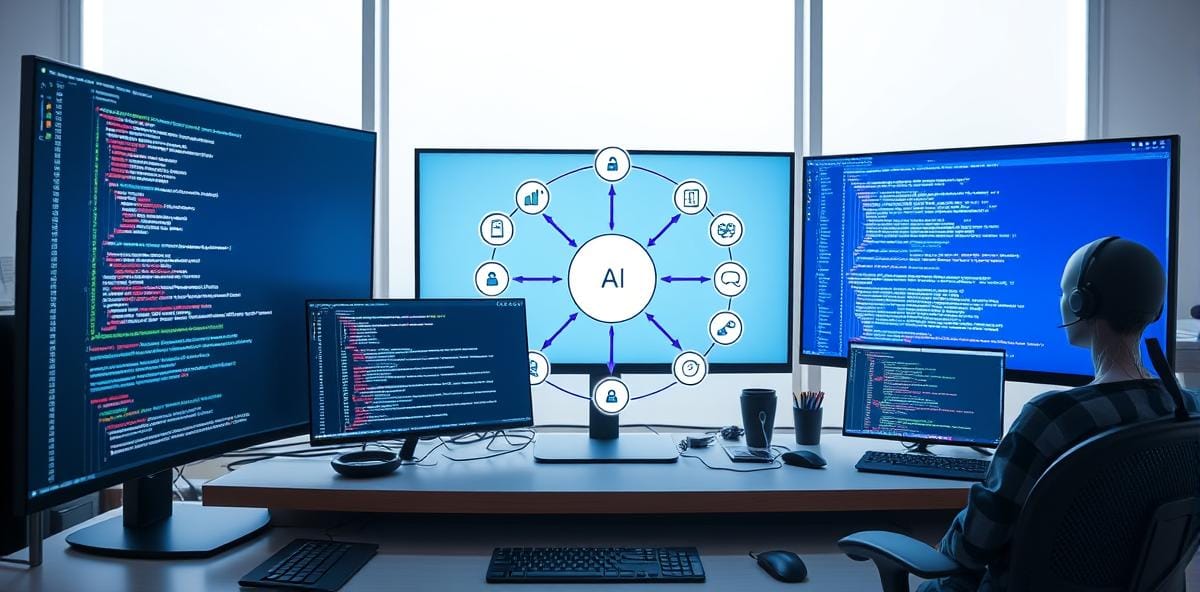
The Model Context Protocol Is Here — And Your AI Agents Need Servers to Talk to It
In 18 months since Anthropic introduced the Model Context Protocol, it has gone from experiment to infrastructure. The TypeScript and Python SDKs now clock roughly 97 million monthly downloads, with over 5,800 MCP servers published. LangChain, LlamaIndex, Microsoft AutoGen, and CrewAI have all adopted MCP as their primary tool-calling standard. Building AI applications in 2026 without it means writing custom integrations for every agent.
This guide covers what matters for production deployments: how to build a robust MCP server, secure it against common attack vectors, and integrate it into your existing development tooling.
What MCP Actually Solves
Before diving into implementation, understand the gap MCP fills. AI agents need access to external tools — databases, APIs, file systems, CI/CD pipelines — but every agent framework speaks a different language. Before MCP, you wrote custom adapters for each integration. With MCP, you write a server once, and any compliant client can connect.
The protocol defines three primitives: Resources (readable data like files or API responses), Tools (callable functions for queries or deployments), and Prompts (templated message sequences). Clients connect via stdio or SSE transport, declaring capabilities during initialization before proceeding through JSON-RPC calls.
Building a Production-Grade MCP Server
The official SDKs handle most boilerplate. What they do not handle well is resilience, security, and observability — the things that matter in production.
Schema Design: Be Explicit About Inputs
Your tools' JSON schemas are the contract between your agent and your infrastructure. Agents use these schemas to decide which tools to call and how to construct arguments. Ambiguous schemas lead to hallucinated inputs and failed calls.
// TypeScript — explicit schema
const deployTool = {
  name: "deploy_service",
  description: "Deploy a service to the target environment",
  inputSchema: {
    type: "object",
    properties: {
      service_name: { type: "string" },
      environment: { type: "string", enum: ["staging", "production"] },
      rollback_to_commit: { type: "string" },
    },
    required: ["service_name", "environment"],
  },
};
Notice the enum for environment. Without it, an agent might invent "prod," "PRD," or "live." Schema constraints prevent these failures at the protocol level.
Transport Security
With stdio transport (common for IDE integrations like Cursor, Windsurf, and Zed), you trust the client process. But servers exposing tools that write to production databases need additional safeguards.
For SSE or network-exposed servers, implement these layers:
- Authentication — Bearer tokens or API keys. The protocol leaves auth to the transport layer.
- Audit logging — Log every tool invocation with agent identity, parameters, and result for incident response.
- Rate limiting — Prevent runaway agents from hammering infrastructure with per-client request budgets.
- Input validation — Re-validate schema-validated inputs against your actual data layer.
MCP in the Enterprise Stack
The real power of MCP emerges when it becomes the integration layer between AI agents and internal tools. Engineering teams are deploying MCP servers connecting Claude, custom agents, and Copilot-style systems to Jira, GitHub, Sentry, Datadog, and Confluence instances.
Instead of copy-pasting context into a chat window, developers ask their AI assistant to pull a Jira ticket, check the latest Sentry error, review the Confluence runbook, and propose a fix — all through a single MCP conversation. The agent composes its own multi-step workflow using tools from different servers.
This pattern is called the internal tool MCP server. It is essentially a thin wrapper around existing APIs with MCP-compatible definitions. The investment is modest, and every AI system in your org — Claude, fine-tuned open models, or custom frameworks — can use the same tooling without per-agent integration work.
Common Pitfalls
After watching dozens of teams ship MCP servers to production, these mistakes show up repeatedly:
- Over-exposing tools. Every published tool is a potential attack surface. Agents with delete capabilities should not connect to production without approval gates.
- Ignoring timeouts. MCP calls can hang. Set explicit timeouts and return structured errors rather than letting connections idle.
- No versioning strategy. Schema changes break cached agents. Implement semantic versioning and document breaking changes clearly.
- Treating prompts as an afterthought. Well-designed prompt templates reduce ambiguity. Expose common workflows like PR description generation as prompt templates rather than expecting agents to construct them from scratch.
The Road Ahead
MCP's growth mirrors foundational web protocols like HTTP and OAuth. It is becoming invisible infrastructure. The EU AI Act obligations taking effect in August 2026 will accelerate adoption of standardized tool integration patterns, since auditable agent-tool boundaries are easier to certify than custom integrations.
If you have not built an MCP server yet, start now. Begin with a single internal tool — CI/CD pipeline, database, or issue tracker. Make it accessible through a clean MCP interface. Every AI system in your stack will benefit from day one.

Comments