
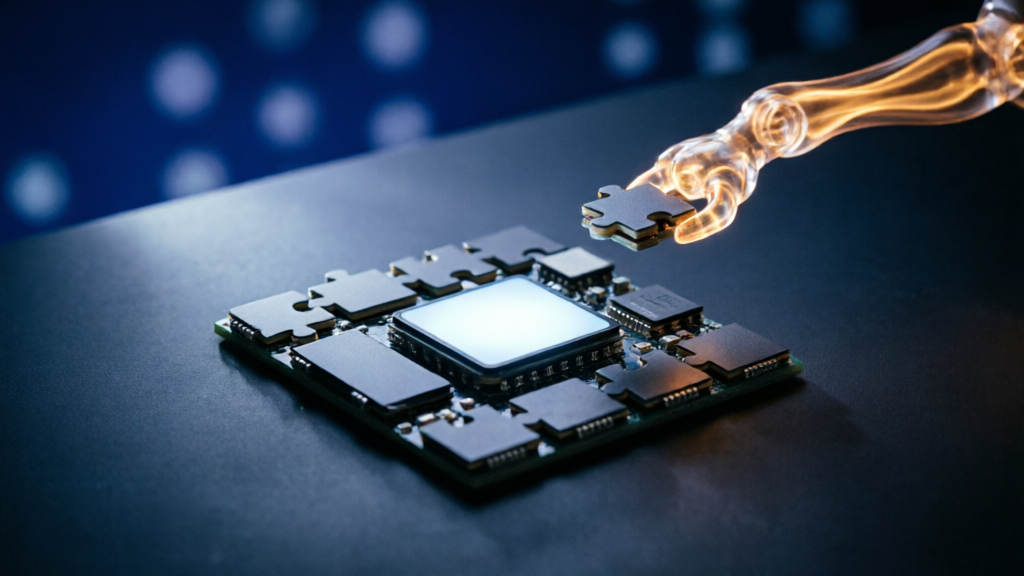
ESP-Mosaico Puts a Coding Agent on the Workbench, Not Just in the IDE
Software was the easy half. An AI coding agent can write, test, and refactor code all day because the whole loop lives in text: edit, compile, run, read the output, repeat. Hardware breaks that loop. An agent can write perfect embedded C and still be useless if it cannot see the LED or know whether the sensor you clipped on yesterday is wired to GPIO 4 or GPIO 7. Espressif, the company behind the ESP32, wants to close that gap. On October 20, 2026 it announced ESP-Mosaico, a modular development platform where the coding agent is part of the product, not an accessory bolted onto the side.
What the thing is
The heart of ESP-Mosaico is a compact host: a 480 by 480 OLED touchscreen, haptic feedback, a built-in battery, USB Type-C, and expansion I/O. Inside sits the ESP32-S31, a RISC-V SoC running up to 320 MHz with 512 KB of SRAM and support for up to 32 MB of fast DDR PSRAM, plus Wi-Fi 6, dual-mode Bluetooth 5.4, and 802.15.4. Around the host sit snap-on modules for cameras, sensors, buttons, lighting, and motors. The important part is what happens when you attach one: the system identifies the module and integrates it automatically, no datasheet spelunking, no pin-map rewrite, no forum-thread driver hunt.
The modularity goes past a single box. Multiple hosts recognize their relative position and orientation and synchronize application state wirelessly, so you join, separate, and rearrange devices as part of the application itself. Espressif pitches cross-screen games and modular displays. I keep thinking about the duller, better use: a sensor network where moving a node across the room is a product decision instead of a rewire.
The loop agents could never finish
Every AI-assisted embedded project before this had the same shape. The model writes plausible code, the human handles physics. You flash the board, press the button, watch the screen, come back and describe what happened, and the model guesses at a fix. Each round trip costs a person's attention, so the agent stays a code generator outside the real workflow. Espressif's answer makes the physical side machine-readable in three pieces.
Module self-identification is the first. When the hardware announces what it is, the agent gets a structured picture of the current device instead of inferring it from a comment in main.c. That alone kills the most common failure mode of AI-written firmware: code written for a board that is not the board in front of you.
ESP-GSP is the second. It is an AI-oriented UI framework where interfaces are structured JSON, validated at build time and simulated on a PC before anything touches hardware. The agent gets defined components, resources, and constraints to satisfy instead of freeform guesswork. A model can generate an interface, have it checked by a compiler, and only then spend a physical device's time.
The third piece is the one that matters: closed-loop device debugging. Espressif exposes flashing, device control, inputs, UI state, performance data, and fault information through unified interfaces, so an agent can flash firmware, poke inputs, read back state, and iterate on its own. Add the BSPs, schematics, SDKs, and reference projects they ship as agent-ready resources, and you have the verification loop that serious software-agent workflows keep insisting on, now pointed at firmware and a real board.
Two doors into the same box
Espressif describes two workflows. Chat Coding uses the built-in agent, ESP-Claw: describe what you want in plain language and it uses the connected hardware's declared capabilities to generate, build, and deploy the app, with no local toolchain to configure. Logic that does not depend on online services runs locally on the device after deployment. It is for people who never wanted to set up ESP-IDF and never will.
Vibe Coding, a name I will be generous about, is the door for engineers. You bring your own coding agent into the full build-test-debug loop through the interfaces above. If you have ever wanted a model to fix its own driver bug on real hardware overnight while nobody is watching, that is the pitch.
A week, not a coincidence
The launch landed in the middle of a pattern. One day before ESP-Mosaico, Meta's open-source Muse Gadget SDK added ESP32 support, with a device SDK built on ESP-IDF and Matter support still in development. Two weeks earlier, Silicon Labs opened its SDKs to coding assistants. Nordic Semiconductor reported record third-quarter revenue on October 22, up 32 percent year on year to $235 million, and noted pointedly that the AI-assisted development tools it launched in May are now used by a growing number of customers.
Even the unglamorous silicon news moved the same way. Renesas launched the RX74M and RX74N on October 22, its first RX microcontrollers on a 22 nm process and the first with embedded MRAM: a 600 MHz core with a megabyte of MRAM that needs no erase cycle before a write, plus a security block Renesas says enables post-quantum cryptography. The edge is getting faster, and it is getting agent-ready in the same news cycle.
Where I would hold the champagne
ESP-Mosaico targets prototyping and makers, not production firmware, and nobody should vibe-code a medical device. The auto-integrated module is also a tidy abstraction sitting on top of exactly the skills embedded engineers get paid for. The day a module misbehaves in a way the abstraction cannot express, you are reading datasheets again, except now you may not know which one applies.
Then there is the attack surface. An agent that can flash firmware through a unified interface is an agent that can brick a device, and worse if that interface is reachable by anything other than your own desk. Meta's Muse bridge already talks to devices over local HTTP APIs. Expose-the-device-loop is exactly the kind of story that ages badly.
A closed loop is only as good as what the agent can read back from it. Flashing firmware is the easy half; the quality of the fault and performance data coming the other way is the actual product. Nobody has benchmarked agent iteration speed on ESP-Mosaico against a human with a working PlatformIO setup.
Who should care
Makers and prototypers: if ESP-IDF configuration is the wall between you and a hardware project, ESP-Claw is a genuine shortcut, and the kit is on sale now. Embedded teams: even if no agent ever touches your production firmware, the harness pattern is worth stealing. Expose flashing, inputs, UI state, and fault data to something a program can query, and your own iteration loop gets faster whether or not a model is involved.
The conceptual shift is the part I keep turning over. For twenty years, development boards assumed a human at the far end of the USB cable. ESP-Mosaico is the first mainstream platform built on the opposite assumption: a board that expects to be programmed, tested, and repaired by a machine that cannot see it. I do not know yet whether that makes hardware projects better. The workbench has moved inside the agent's loop, and that is a bigger change than another touchscreen on an ESP32.
Comments