
Anthropic's Model Hardware Standard Cuts Lab Setup From Months to Minutes
For the past year, agentic AI has been impressively useful and almost entirely trapped inside the computer. It writes code, drafts text, generates images, and files tickets. All of it happens on a screen, against APIs, in a world that has no weight and no inertia. Anthropic just announced a standard called the Model Hardware Standard, or MHS, and it is aimed squarely at the part of the job the models have not been able to touch: the bench, the robot arm, the microscope, the physical thing in front of you.
What MHS actually is
MHS is a set of standardized drivers. The idea is that every device you want an agent to control, a camera, a laser, a robotic gripper, a piece of lab instrumentation, exposes the same interface and speaks the same data format. Instead of writing a custom "translator" program for each pair of devices so they can talk across a network, you point them all at the standard and let them coordinate on their own. Anthropic frames the payoff in plain terms: setup work that used to take weeks or months of fiddly integration should collapse down to hours or even minutes.
There is nothing in a common machine interface language that requires an AI model at all. Anthropic is clear that MHS devices can be driven directly from the command line or from plain API code files. The model is optional plumbing. What the standard adds, when you do hook a model in, is the ability to reason about the experiment in flight.
Where the idea came from
Anthropic staff member Alek Kemeny says the project started by watching a neuroscientist, Arco Bast, build a memory-formation experiment at the HHMI Janelia Research Campus in Virginia. Bast had written an interface to make the rotating laser beams, microscopes, cameras, and the dozen other components of the rig actually work together. Kemeny has said that watching it clicked: a shared interface like that could let an AI run any experiment in the world. MHS is essentially an attempt to generalize Bast's one-off glue code into something you can drop onto arbitrary hardware.
How an agent would actually drive it
The natural-language half comes through the Model Context Protocol, or MCP, the same layer already used to hand tools to models. Point Claude (or any MCP-connected model) at an MHS rig and it can be told what to do in plain language. Anthropic describes the model reasoning through each step, updating parameters in real time, and in some cases recovering from hardware errors without anyone stepping in.
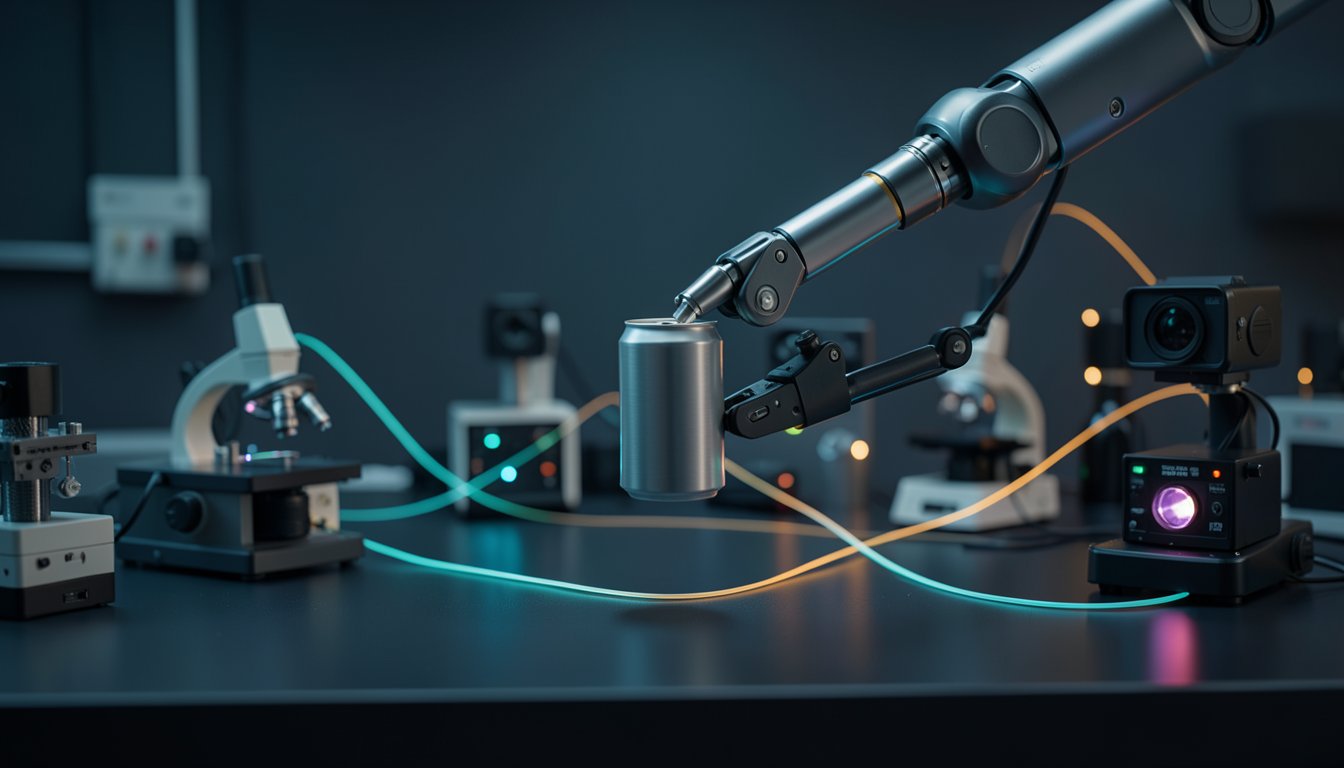
The examples Anthropic shows are concrete. One model adjusts a laser, checks the result through a separate camera, and repeats the loop until the whole system is calibrated. Another focuses a microscope, reads what it sees, decides which region needs more attention, and drives the stage to that region to keep going. In a demo clip, Claude figures out how to get a robotic arm to pick up an aluminum can even though it was never specifically trained on the steps involved. And rather than re-deriving every step on every run, MHS models can sequence the whole procedure by writing API scripts once and then adjusting them as conditions change.
The tagging system is the underappreciated part
Models are trained mostly on the virtual world, so a robot arm that can lift two kilograms and reach forty centimeters is information they may simply not have. MHS pairs the interface with a standardized tagging format that encodes a device's real-world constraints: physical characteristics like weight and reach, the parameters it can adjust, what it can measure, and the safety limits that are enforced on it. That tag file can be loaded into a model as a quick reference for hardware it has no prior experience with. It is a small, unglamorous piece of the design that does a lot of the actual work of keeping the model honest about the physical machine.
Who is in the preview, and what comes next
This is a research preview, not a release. Anthropic says it is working with a first group of scientific labs and advanced manufacturers during the preview period, and the named partners are telling: Amazon Web Services (via Strands Robots), Hugging Face (LeRobot), Raspberry Pi, Automata, and Universal Robots. The stated goal during this window is to build safety evaluations and best practices for AI systems operating physical equipment. The endgame is for MHS to become an open source, agent-agnostic standard for tying AI to the physical world.
Early testing with scientific partners over the past year reportedly showed MHS cutting the time to integrate devices, which the company says let its partners iterate faster across a range of experimental setups. Kemeny's framing of why that matters is worth repeating: if you can test hypotheses faster, you can build general technologies faster. He puts the bet as condensing a century of progress into a decade.
What to watch
The claim is bold and the hardware in the demo is the friendly kind, a robot arm grabbing a can, calibrated lasers in a controlled room. The real test is everything that is not in the clip: safety limits that actually hold, hardware that fights back, and the long tail of devices that never got a clean driver. The tagging system is where a lot of that risk lives, and the preview period is explicitly about stress-testing it. If MHS settles into something open source and model-agnostic, it quietly becomes the USB of the physical agent stack. If it stays a research curiosity, it still points at the obvious next frontier: getting the models out of the browser and onto the bench.
Comments